Teach.com
Showing posts with label teaching. Show all posts

Thursday, July 28, 2016

Let's Make a Maker Space

https://hildakweisburg.com/2016/01/04/on-libraries-makerspace-magic/
Right up front I want to say that any school that has a Maker Space because that's what great schools have, is missing the whole idea. I think playing with things and trying out things is really cool. I do. But if we haven't thought through what we will have in our space then will it truly be a space for all students?

There's that WE again. When WE are thinking about a maker space, then the first thing to think about is who is this WE we are talking about. WE should include anyone who controls the purse strings for purchasing items. WE should include the students who will be using the space. WE should include parents who might want to be involved in the space. WE should include teachers who might want to encourage students to use the space but also might want to use the space themselves.

Purse String Holders - How much will it cost for the initial purchase of items, for the maintenance of items, and for the replacement of items? If WE haven't thought about those items then the space won't be a success.

Student Users - What do the students want to do in the space? And, at the same time, what should be included in the space that the students haven't even thought of wanting?

Parent Participants - Some parents always want to be involved with the school. Some parents feel that they just don't have time but they are willing to purchase/collect/make items for the school. What do the parents want for the space? Do they want time when they can use it? Do they have expectations for what happens when their child is in the space? Do they want to volunteer to be in the space so that other adults (from the school) won't have to be in there?

Teacher Participants - Do the teachers have a certain expectation for what items should be in the space? Do the teachers want to be able to send students to the space at any time, knowing that there will be an adult presence to monitor the kids? Are there other ways the space can be used?

Last year was my first year at my current school. Several times I was told that there were parents who wanted the school to have a maker space. Well, where would this space be? What are the hours of the space? Will there be a requirement that there has to be an adult in the space at all times - or could we have a certification program for our older students who could be in the space during their study hall or after school.

Here are my top dozen questions compiled into one list:

      1. What do the parents want?
      2. Where would the space be located?
      3. Who would monitor students while it is open? 
      4. What would be the hours that the space is open?
      5. Will parents be able to provide items for the space? 
      6. What is the initial budget for materials for the space?
      7. What is the annual budget for materials for the space?
      8. Would there be a certification process for any tools and for general safety?
      9. Will teachers monitor the space? And, if so, when is this going to happen?
    10. Will parents sign up to monitor the space? How does that look from an insurance stand point?
    11. What do the students want (at each level. We're K-12 2nd graders and 10th graders have different desires) ?
    12. Will students be allowed to leave their classrooms to go to the space to work? If yes, how do we make sure that there aren't too many students in the space?

http://www.fractuslearning.com/2016/01/26/how-built-school-makerspace/

And now, for my readers, help me compile a list of materials that should be in a maker space (leave your thoughts in the comments section). Who knows, maybe there'll be a grant with our school's name on it and we can get this thing off the ground.  Here's a general list to whet your whistle -

     A. Legos and a Lego Table, KNEX, Blocks
     B. Basic hand tools (screw drivers, hammers, allen wrenches, adjustable wrenches, pliers)
     C. Yarn and Thread
     D. Tools for knitting, crocheting, sewing
     E. Painting Supplies (But what, exactly???)
     F. Computers/laptops for online access
     G. Rulers, T-Squares, Straight Edges
     H. Paper of various types
     I. Nails, Screws, Bolts
     J. Circuitry and wire
     K. Various types of tapes and glues
     L. Storage Containers and Shelves
     M.Craft supplies (Popsicle sticks, tooth picks, material, card stock, cotton balls etc.)

Thursday, July 7, 2016

Design Thinking or PBL, A Chicken/Egg Scenario? My journey.

http://www.science20.com/gerhard_adam/chicken_and_egg_problem_view_evolution-107927
Last night I missed a great conversation during a Twitter chat hosted by #MeritKCI and involving my friends who frequent the #dtk12chat. As I was scrolling through the tweets from the chat I noticed some discussion of PBL and how different Design Thinking (DT) is from PBL. A blog post that was referenced (and also one of my favorites) was written back in 2012 by Ewan Mcintosh of Notosh.com.

What's missing in these 140 character exchanges is some historical perspective and some grounding in where classroom teachers are in 2016. Before going further though, it's important to understand where my belief system lies and where I come from. I love student exploration - fueling inquiry and that innate desire to learn about things. I am against grades and, instead, am for student assessment through creativity, self analysis, and reflection. I believe in backward design but also in problem creation. I am also grounded in where the education world is today.

Parents, and I'm one, want their kids to be able to "be a kid," to explore, and (at the same time) get into great schools that will introduce them to unique learning opportunities. These school should then provide a foot into the door of a company that will help the students pay off their college debt. Many (most?) of these "great" colleges require a certain score on a standardized test (SAT/ACT) and a certain class rank based upon a 4.0 grade point average.

High schools are charged with getting students college and, lately, "career ready." Students must learn certain things mandated by their community, their state, and by the national government. The national government creates a list of "standards" that must be met. The state government creates a list of standards that must be met. And then school districts create standards that their students must meet to be labeled a high school graduate. More and more of these standards include the words "Explore" and "Hands On" but it really is up to the the teachers to bring in the "how" to do that exploration.

At some point years ago teachers started finding ways to engage students in their learning through an idea of centering the learning around a specific task or problem.  Although the idea of teaching in a mode that was focused upon a project had been around for about a century, it was a couple of dozen years ago that this was labeled (as we know it today) as Project Based Learning or Problem Based Learning - PBL. Schools/Companies/Corporations in Northern California jumped into this and we suddenly had the Buck Institute for Education (BIE) and the New Tech Network (NTN).  As these entities trained teachers and/or opened PBL schools the popularity of this PBL-thing increased and more groups started training teachers in their version of PBL.
http://www.peertutoringresource.org/2014/07/a-quick-start-guide-to-using-project-based-learning-pbl-in-the-classroom/

Around the same time this was happening schools were rapidly removing "Shop" classes and other hands-on classes for students because schools wanted to focus on courses that were academically rich. But this wasn't happening everywhere. In Upstate New York a company was created that focused on engineering principles - Project Lead the Way (PLTW).  In 2010, as I finished my 2nd year as a math teacher in a New Tech Network school, I was given the opportunity to teach a PLTW class, Introduction to Engineering Design (IED), and I went to my first PLTW course. That same year I saw for the first time a Nightline piece about a company called IDEO.

I started thinking about the marriage of the design process and the pbl process. And, coincidently, I found out about and read a new book called Make Just One Change from the Right Question Institute.  If we could get students to ask more questions at the start of each project might we improve the student inquiry process? And, in turn, might we not help teachers see that we can allow students the opportunity to explore the content and not just follow a road map that we (the teacher) created?
From PLTW

In 2012 as I was about to "finally" figure out this PBL-thing that I was floundering in, I was promoted to an Instructional Coach position with the charge of helping a middle school bring in PBL as the primary mode of instruction. So, before I was able to perfect my own teaching practices I was asked to help a staff of nearly 50 learn and perfect the art of being PBL teachers. That's when I started to really see the push back from teachers who felt that they were in a no-win scenario: state test scores must improve and they must be doing PBL in their classrooms. We were a NTN middle school with a NTN coach but we weren't doing PBL the "right" way. After two years we all decided that the school and NTN needed a break from each other. And I felt like a completely incompetent instructional coach. Why didn't PBL succeed in this school?

Later that year I started the training to become a National Faculty member of BIE so that I could reflect on my own PBL knowledge while facilitating training for teachers in school districts who were looking for a way to bring this PBL-thing into their schools. While immersing myself in all things PBL I came across a group of teachers who were talking about using a design thinking approach (DT) in their classrooms. In discussions with some of the folks I considered to be PBL guru's I was told that these DT teachers weren't going deep enough with the content and that PBL was what really got students going deeper. "Wait," I thought, "wasn't the big push back to PBL the notion that in projects students didn't go deep enough - it was just bells and whistles?"

DT was undergoing the same scrutiny that PBL had when I first was exposed to it years earlier. And, I should add, I was still hearing that push back from teachers in PBL trainings - "How do we know that the students will understand the content to do well on standardized tests?" -and- "This will never fly with our parents/school board/students."  In 2015/2016 BIE and the National Faculty members took a hard look at what PBL should look like for all students and in all classrooms. Because every classroom is different we wanted to create a "standard" that all teachers should be striving for in their schools. We came up with what we now are calling Gold Standard PBL.

In introducing this new Gold Standard to teachers one aspect jumped out to me: we now want teachers getting their students to ask questions through the use of the Question Formulation Technique (QFT) from the Right Question Institute. I had first learned about the QFT when I read Make Just One Change. BIE was now specifically stating what I had thought about way back in 2012.

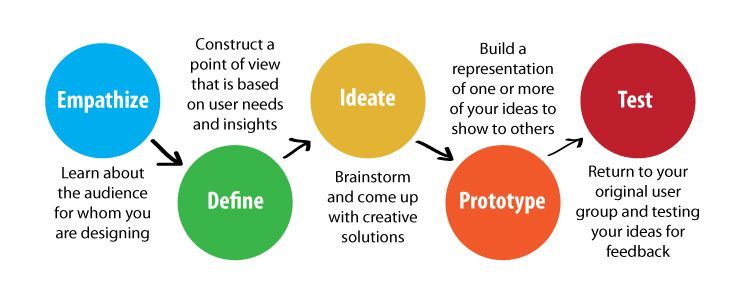
Now let's overlay the flow of design thinking. Here are two representations (with notations) of this:


Empathy is the obvious thing not mentioned in the Gold Standard. So, in my mind, a good PBL teacher must get their students looking at why we are doing this project. Who are we doing it for and why should the student care about doing it? Along with empathy at the start is building what I call empathic inquiry throughout the project. Are students getting feedback from those whom they are creating for throughout the project? 

And so, again from my perspective, doing gold standard PBL while following a DT path is the best of both worlds. These are not (and should not be considered) separate entities. What are we looking for in all of this? We want students who are aware of their surroundings; are aware of the needs of others; are inquisitive about how and why things are the way they are; and, who are given the chance to experience the creative process of imagining a result, attempting to create the result, reacting to feedback for improvement on this initial result, and persevering to complete their final result. 

I am now back in the classroom in an International Baccalaureate (IB) charter school in Texas. I am creating projects in coordination with my fellow teachers. I organize my project ideas using Project Based Teaching Practices from BIE and I use the DT flow shown above. I have found that it doesn't matter whether you think DT is better/different than PBL or that PBL is better/different than DT. What matters is that you are creating a classroom where students feel safe to take chances, make mistakes, and build resiliency. 

Tuesday, February 23, 2016

Thanking a Teacher In My Life

This past weekend I heard about a project being run by People Admin. They offered money to hear stories about people who inspired you to become a teacher.

So I sat down and whipped up this thank you to a teacher who inspired me to become a teacher. Enjoy -----

In 1990, at the age of 32, I was at a crossroads. My wife and I were both active duty Naval Officers serving aboard ships. Her ship was out of Norfolk, VA and my ship was out of Long Beach, CA. One of us needed to leave active duty. Over dinner we discussed the pros and cons of each of our futures in the Naval Service. My wife turned to me and said the magic words, “ At least you know what you want to do if you get out.” 

At that point she told me that I had always spoken of being a high school math teacher and a baseball coach. I never realized how often I had said that,  but I knew she was right. By the end of 1990 I was out of the active duty Navy and I was enrolled in graduate school. By the end of the Summer of 1992, I had my MSEd and my certification to teach math and science.

Where did this desire come from? Partly from the fact that I had two Great Aunts who were both teachers and my mother was a secretary in an elementary school. It seems that I had always been around educators and their “school talk.” But the main reason I ended up taking this route was because of my high school junior varsity (JV) baseball coach and math teacher - Mr. Pete Austin. 

Mr. Austin was a very demanding coach. You played his way or you didn’t play at all. Our JV baseball teams were a force to be reckoned with in our state. We played hard and we played the game with passion - just like our coach. He showed us that you would be rewarded for hard work.

In the classroom he was equally as demanding and he rewarded students who worked hard. He expected us to stand up and be bold with answers to questions. Wild guesses and “maybes” in a student’s answers were discouraged. And he wasn’t afraid to throw a chalkboard eraser in your direction to keep you on your toes - (always followed by a smile, I should add). 


One of his ways of helping us with low grades was to give a minimum grade of 50 on any assignment. The downside of this was that he would announce the members of the “50/50 Club.” I was a proud member of that club. But at the same time, my math skills were at such a high level that I went on to be a math major. At reunions we still talk about being in that infamous club.

My take away from this interaction was that teachers can be tough and demanding on their students while being compassionate and loving at the same time. There was never any doubt that Mr. Austin cared about us and he wanted us to be the best. That held true whether we were on the baseball diamond or in the classroom. 

I never made it back to thank this person who so inspired me in life. I only hope that one day his family will be able to see this and will take pride in knowing that he made a difference in our lives. What he showed me then is making a difference in my students lives today.

As I work with new teachers I make sure to encourage them to be firm and consistent in their classroom management. I make sure that they understand that they also need to show love and compassion. That’s the way I was treated in my high school pre-calculus class, that’s the way I treat my students, and that’s the way I want my own children to be treated in their classes. 

Thank you Mr. Austin for inspiring me to pursue this incredible journey.

---->   For those of you who remember Mr. Austin, feel free to leave your own memories in the comments below. I know that there are those who were afraid of that chalkboard eraser and Mr. Austin's style in the classroom and on the baseball field. I obviously loved how he worked and I know it helped make me a better person. So, if you do have any unpleasant memories, please remember to numb the sting before hitting submit.  Thank you.

Monday, January 18, 2016

Using An Old Challenge to Teach Project Management

http://goo.gl/AK0vs
When I talk with teachers about getting started with PBL I often tell them to think of something they have seen done before and take the idea and make it their own. But I also caution them to think of their content first - what are the verbs and nouns in their standards? Unless they are incredibly comfortable with their standards it really doesn't make much sense to start with an idea and try to fit the standards.

Now that I'm teaching Design this frees me up to be more creative and experimental with where I ask my students to go with their learning. Unfortunately I have 7th graders who have been living, for at least a few years, in the world of "Learn the Content -then-Do a Project." In addition to teaching them about the Design process I have to teach them the the PBL process.

I'm attempting to create a classroom of asking questions, taking chances, making guesses, trying new things, and thinking about the client. Through the first semester my students have worked on projects that were centered on content standards for their science and Texas history classes. In science they needed to understand forces for the Rube Goldberg Machines they built. In Texas history they needed to understand French and Spanish settlers/settlements in the 17th and 18th centuries in what is now Texas to build models.

The content might have been for other classes but the creation and building were accomplished in my classroom. Now, with this next project, my students will be working for me (and for themselves). We are embarking on my version of the Cardboard Chair Challenge.

You might have guessed from the title of the project, that the main idea is to build a chair out of recycled cardboard and glue. But there is SO much more I want them to learn about managing a project. This, in reality, is a project management project.

To keep them focused on creating the chair and to make things interesting I have created an opportunity to have the students present to parents. There's nothing like an authentic audience to up the ante. To be honest, I don't really care whether they successfully build a chair in the short time period I have given them (but don't tell them that, shhhh.)

Things I am focusing on:
(1) Roles. In this project everyone has an individual role and everyone is responsible for making sure the final products are completed. There are 6 students in just about every group and I have 6 roles in each group. The roles are Group Leader, Work Leader, Group Liaison, Web Site Designer, Artistic Leader, and Promotions Leader.  For the first two weeks I'll be meeting with each of these role players every day to ensure they are on top of what needs to be done to be successful.
 (2) Leadership. Related to their roles, everyone in the group is responsible for something that they will need help with. Will they step up and be a leader to make sure the group is successful. One role I will be working very closely with is the Work Leader. I expect the Work Leader to create a Team Accountability Form and use it every day. The Work Leader needs to be on top of what every member of the group is doing and where they are on their individual time line.
(3) Working on both individual and group work. Can they work together on their product (the chair) while also working on their individual assignments based upon their roles?

I want my students to understand that their is a lot more involved in successfully completing a project besides the final product. My students are competing to create the "best" chair possible using just cardboard and glue. But they are also learning how to work together as a team.  And with that, I can truthfully say: I want them all to be winners.

Sunday, January 3, 2016

I Go From Project Idea to Project Launch (PBL with a DT Feel)

https://www.flickr.com/photos/nasahqphoto/
I've just completed a pretty darn nice 2 weeks off for the holidays. Tomorrow I head back to 2 days of PD before the students come back to me on Wednesday. I've been spending the last couple of hours fine tuning my first design project of the year.

This is my first year of teaching MYP Design at Meridian World School. And so I've been creating as I go, as far as what I cover next with my students. Things that work this year will be tweaked and recycled for next year. Things that didn't go so well will be revamped or scrapped for next year. It's all part of the DT mindset and, either way, I learn a ton along the way.

Back in August (2015) I decided that I wanted to do a Cardboard Chair project this year. There are several versions out there but I chose to follow this one. I modified it, as necessary, to meet the level of my 7th graders and the time I wanted to spend on this project. The beauty of this is that I am working with something that has worked in the past.

I took the major parts of the project as written ( Research, Design Sketches, Drawings, and Model) and I added a beginning (Admin) and an end (Build and Presentations). Then I went through each of these and wrote out some sub-parts. For example I listed time for building and presenting the prototypes for feedback prior to their final build.

Next steps were to figure out how many days and weeks it would take and to look at the school calendar and see what things might impact these times. In doing this I noticed that our Diploma Program (DP) students will be doing their Group 4 Projects at about the same time I wanted to finish my project. I had my Authentic Audience - DP Parents can help pick the design champions.

As I worked backwards on the calendar I started filling in the key steps and, before I knew it,  I was back to early January and I could start finalizing my plans for these first two weeks of the semester.

Let me go through my checklist:  I have a project launch day where we will assign groups, write group contracts, and do the Question Formulation Technique (QFT);  I have a presentation day and an authentic audience;  I have days for research on key components for my subject area (Form, Function, Resources);  Students will explore empathy through their design plans; and, Students will do research, create sketches, and will build prototypes to get feedback prior to their final build.

I have been able to marry most of the Gold Standard PBL elements with most of the Design Thinking elements.  This will be a five week project from launch to final presentations. It will encompass the majority of the first six weeks of the grading period. I'll need to add assessments and plan for materials but, in the end, I am all set for the first 6-weeks of the semester. In a couple of weeks I'll be ready to start finalizing my next project. I've already approached a gym teacher to design some exercise mats. I'll write about that one soon.


Thursday, December 10, 2015

Building Empathy Through Interviews

www.floridamemory.com/items/show/32039
7th graders are all over the map when it comes to emotions. So, on one level, you might think that it isn't hard to get them to develop empathy. But how many of your students, at any grade level, have conducted interviews to gain knowledge of their interviewee?

My first semester at Meridian school is winding up and I am still getting used to the timing of projects. That led to a two week period between the Thanksgiving break and final exams.

I knew that I wanted to introduce an interview process soon. I also wanted to include either the 7th grade ELA teacher or the PE Coach with a project early in the next semester. And then it hit me - 6 Word Memoirs.

As the name implies, students write about themselves by using only 6 words. After checking with the ELA teacher I found that she had just completed a unit on memoirs. And, after talking with a few students only a handful had done a 6 Word Memoir (6WM) in the past. And so it began...

On the first day I gave the students a post on interviewing like a pro. It doesn't exactly apply but I wanted them to think about what the pros think about before, during, and after an interview. To minimize time on the article I had them do a jigsaw and we discussed things they learned about what to do before you go to an interview; what you do during an interview; and what things to think about after the interview.

Then I paired them up (key word there, "I" paired them up).  Many were with people they don't normal hang out with so getting to know them became a harder task. I gave them 10 minutes to come up with a set of questions to use as openers. And, I instructed them to go down any path that became an obvious interesting topic that might be used to write a 6WM.

To help them think, I gave them a list of topics that might be good places to draw from for questions.
The trouble is I forgot about how the 7th grade brain works. Because I put a list in front of them, they couldn't come up with imaginative questions or question sequences to go deeper on any other topics than the ones I presented to them. I actually heard one boy ask another "Have you ever been married?" When I heard that question I asked why he had asked it. He said "because I had included "marriage" on my list of possible topics." Silly me; I was thinking that maybe there might have been an interesting wedding that they might have attended.

By the end of class I actually was pleased with the results from most of my students. They had asked good questions and had made good recommendations to their interviewees on what they should write their 6WM about.  Very few ended up needing help in understanding the process and how to make a relevant recommendation.

Before the next project starts I will be able to draw from this experience as we discuss interviewing to gain empathy. Because when the next semester starts (after our holiday break) I will be having my students interview clients or other pertinent people before they start brainstorming ideas. I feel better about their interviewing skills and I believe they will be better at identifying the needs and desires from those that they interview.

To finish the 6WM, I am having them go through a critique rotation today. They are writing their 1st draft and are presenting it to their small group. The small group is tasked with recommending at least one word to be changed to make the 6WM stronger. Then the students rotate to different groups and go through the process a second time.

They will be turning in an 8.5 in. by 11 in. paper with their 6WM on it, that has been decorated to help tell the story. These will be placed on our classroom wall so all of my classes can see what the others have written.

Sometimes a quick 2 week assignment can bring out a lot of learning. In this case my students have learned about how to be a good interviewer. My students have also learned more about their classmates. And, I have learned more about all of my students. Sounds like success.


Saturday, November 21, 2015

Smart Kids Need Competition Too

http://www.un.org/depts/dhl/maplib/flag.htm
Not a very smart title to this post because many of you will have seen competitions such as Speech and Debate , or  Robotics Competitions, National Academic Quiz Tournaments, or even Model UN.  But there are others who may not realize what these competitions are all about.

If you are in that camp then I would like to suggest that you find where your school's academic teams are competing and go and support them.

This weekend I am attending my first Model UN. It is the Central Texas Model UN (CTMUN) and is hosted by the University of Texas. I have brought 21 students who are mostly 10th graders.  For several students this is their 4th or 5th MUN and for others this is their first. After an opening ceremony last night there was a first session that lasted until 10. These students were in classes all day, withstood a nearly 1 hour drive in crowded vans, and then participated in their first sessions.

As we walked to the vans, at the end of the night, the energy was palpable. There was laughter and discussions about students who they had encountered at other MUN's (both good and bad comments were bantered about). I talked with the students about the Saturday sessions and the end of the day "Social." I almost fell to the floor with laughter on hearing the description of what the MUN Social is like: "It's just a dance with some food. But it's fun to watch nerds, who have had no contact with the outside world, getting sweaty and grinding on the dance floor."

MUN is a perfect specimen of 21st Century Skills on display. Students have to think critically, communicate ideas, cooperate and collaborate, and many will show their creativity by using accents based upon their country or even dressing in character.

And they do so for HOURS.  Today I spent much of the day in the session where students were representing Japanese leaders in the 1850's. They started discussions based around the last decade of the Shogunate starting right after Commodore Perry's arrival. Whether to include the US in a trade agreement was considered.

As I came in and out the years progressed and as I am sitting here right now they are discussing whether to assist the United States (Union Troops) or Confederate States (Confederate Troops) or whether to stay neutral. We have obviously moved into the 1860's but the discussions are still as emotional and the delegates appear to have just as much energy as they did when I first came into the room 8 hours ago.

And how many spectators do we have for this incredibly exciting and entertaining competition? Right now I AM the spectator in this room. In no room have I seen more than 3 spectators (including myself) all day. And all of the spectators I have seen are wearing badges, like myself, that indicate that I am a school sponsor.

I interrupt this writing to say that we just lost a delegate who disgraced his people for working with the Chinese. There was a trial with 2 Pro and 2 Con speakers. The delegate on trial was found guilty and was sentenced to death. A MUN moderator appeared, asked the delegate to rise and plea for his life. While mid plea he was viciously stabbed by the MUN moderator and he died on the session floor.

From this point forward he will be a Spirit, although there was some discussion of calling him Zombie for the rest of this session. [No students were actually hurt during this session!]

So far this weekend I have rubbed shoulders with Vladimir Lenin, who has been in and out of the Russian Revolution sessions, and various public figures who arrive periodically to add flavor to the discussions.

As I come to a close they are debating whether to take control of Hawaii; to side with the Union by sending troops into California; or to invade China or the Philippines.

This writer rises in defense of academic competition and asks that we have a vote on making these spectator sports. This delegate recognizes that, in the past, we have not had large groups of supporters for these events and it is time that we show that our academically talented students need our love. This delegate yields the rest of his time and takes his seat.

Sunday, October 18, 2015

Still Ripping Educators Off

https://www.pinterest.com/pin/171347960792965587/
I started (this current round of...) getting upset about this (continuing) problem of educators being ripped off for supplies, a couple of weeks ago. I was talking about it with a fellow educator and he reminded me of a time when a teacher went to the vendor floor at a conference. She commented on how expensive this one item was and the vendor said, "Why are you upset? The school district pays for it anyways."

Those outside of the teaching profession assume that we get such a great deal and "the district just pays for things." Even if that WAS true, and it's not, I'm a tax payer in a school district and therefore I help put together the funds that are to be spent. I don't need my school district being ripped off when they are using my money!

So then, today, I wanted to price 4 inch to 6 inch balls that I want to use in a project down the road. I figured I'd start by looking at foam balls and that they would be the cheapest. Within minutes I had been to several sights, including Oriental Trading Co (a teacher go-to site) and Amazon.com.  I found what I was looking for in the 50 to 75 cents a ball range and was doing some mental calculations that I would need 50 to 75 dollars to get the 100 balls that I wanted.

Then I went to Discount School Supply. Doesn't that sound like some company trying to help us teachers out? Well, not so fast. These guys wanted $2 a piece for the balls. That is more than double the price - for foam-stinkin-balls! I would be more upset but I have seen this since my days in the military. "Oh, is that being purchased for a government entity? We'll mark it up 100%"

When you see the statistics about the amount of money a teacher spends out of their own pocket on school supplies each year (probably averaging in the $500 to $1000 a year for me) it really galls me that these places would charge double (and often 3 or 4 times) for something that could be purchased somewhere else. No wonder crowd funding sites are so popular with teachers (such as Donor's Choose).

I'm going to get balls for my project. I'll spend 50 to 100 dollars from the look of it. But I won't be spending any money at any of the "discount educator" sites. They can wait for the purchase order that I'm not filling out because I'm using my own money and NOT my school's money.  Grrrr...

You may return to your regularly scheduled lives.....(and I'm pretty happy that I kept my maturity with this post and didn't say anything like, "I got my balls in an uproar!" - That would have been wrong.)

Friday, October 9, 2015

You See, It Takes Time

https://www.flickr.com/photos/badboy69/
We are seeing a real dichotomy in education these days. Thanks to social media we are exposed to teachers, at all levels, doing wonderful things with their students. We're seeing students doing incredible things that they have chosen to do - not because they are completing an assignment that they have to do.  

We are seeing images of happy and excited people from gatherings of educators at edcamps, conferences, and webinars. And we're also seeing students in these images. Students - outside of the normal school day!

Then there is the reality of schools being labeled as "low performing." And students dropping out of school because they perceive life will be better with their gang family or, sadly, because they need to provide for their family. The images we see are of unhappy and, often, angry students. 

Between the two extremes lies the average school in the average district. And, at the average school, teachers are pressured to meet certain test requirements. To meet these requirements they must follow a strict curriculum with every day mapped out for them. They don't dare deviate from the course. The strict curriculum is designed by "experts" who know that teaching a certain topic in a certain way will guarantee the average student will succeed. And by succeed they mean pass the state test. 

But there are INCREDIBLE things going on all over the world. Students are going deeper in their learning. Student attendance rates are improving. Students are, (gasp), having fun and are enjoying learning. If students are attending classes and having fun in school then maybe, perhaps, their scores on state tests might just be improving! What a crazy concept!

Schools are having success. But there is this little statement that stakeholders in schools hate to hear - it takes time.  We saw it at Manor New Technology HS. My first year our scores in math were not good. There was hope that I, the "Old Math Teacher," could suddenly make things better. But what was lost on all of us was the fact that we were doing things differently. Our students had to learn how to learn and our teachers had to learn how to help students learn in this world of project based learning (PBL).  The superintendent and principal bought into the idea of "Trust the Process" and the teachers had incredible support and autonomy. We could try new things, and fail, without a huge to do about it.  And the school's scores started improving. 

All it took was time and the willingness of stakeholders to allow things to not go well so that we could figure out how to do it right. States and school districts have got to be willing to take risks and try new things with their students. Even though things might not immediately improve.  Are you willing to try something that excites students? Are you willing to try something that increases attendance rates? Are you willing to try something that keeps students from choosing life without school? Are you willing to give it 3 to 5 years? Are you willing to see test scores, possibly, stagnate or even go down? All we ask is for you to Trust the Process. Because, you see, it takes time. 

Monday, August 10, 2015

Putting Together a Design Class in a IB World School (Part 2)

Screen Capture from - https://goo.gl/VoUfRT
[NOTE: Originally written a week ago]
"So much time and so little to do. Wait a minute. Strike that. Reverse it. Thank you." Willy Wonka.

 Right now I'm feeling like a cross between the Scarecrow ( giving directions in OZ) and Willy Wonka these days. One minute I'm heading one direction and the next I'm heading in a completely opposite direction. But, the bottom line is that, wherever I end up heading needs to be a direction that helps our students and our school. I can live with that.

A long time ago (yesterday) I wrote the first part of this group of posts. At that time (yesterday) I felt like I was starting to see the light at the end of the tunnel - the tunnel of planning what my class would look like this year. Evidently the light I was seeing was a warning sign that said "Detour Ahead."
https://www.flickr.com/photos/shannonmary/
It now looks like my focus needs to be around the word Community. What does it mean to be a part of a community:   The classroom community, Our school community, Our "local community," and the world community?

The first project, that I will be doing with my science teacher neighbor, will now focus on my helping my teaching community. We will do the Rube Goldberg Machine because of the teacher's needs to teach certain concepts like momentum and speed.  We will build because of the need to have visual representations of the science concepts they will be learning. We will be doing all of the other components of the project so that everyone in my classroom community understands the parts of the design process.

For the school community I will be making sure that my students are learning the IB concepts at the MYP level. This will build on their years of learning these concepts at the PYP level. And throughout this unit, and the rest of the year, I will be referencing how our learning impacts (and is impacted by) the local and international communities.

It will be a time for me to join the Meridian World School community as well.  Let the school year begin!

[END NOTE: Stopping here. This was to have gone out last week. It's time to start writing the next post. School started today. And we are rolling! Come join my community. ]


Monday, June 29, 2015

In Which We Are Introduced to My New School

https://goo.gl/xAkChH
On August 10 I will be starting a new school year with new students at a new school. But what does that really mean? Every year we get new students. Every year is a new school year. The only really new thing is the school I will be working at - Meridian School in Round Rock Texas.

I interviewed for this school so I've actually stood in the building before. I even met a teacher from this school at SXSWEdu. He enlightened me about the fact that the school was K-12 (and not just an elementary school). I even suggested this school to another teacher-friend of mine and he not only applied for a job; he was hired to work there.

But my accepting the job is less than 2 weeks old and I haven't been able to go to the school since to see what it looks like or even finish all of the paperwork for the job application. Yet on August 10th there will be students walking into my classroom. It is NOT too early to start putting together my teaching strategy.

Meridian School. I am a retired Naval Officer and have taken many hours of navigation classes and have spent hours on the bridge navigating ships around the globe. So I know what a meridian is. But why meridian for the name of the school? I looked to see if there were other meanings to the word meridian and I found that there was one that I really liked (whether this meaning is the one meant by our school's founders, I'll have to wait to see):

 "Meridian - Any of the pathways along which the body's vital energy flows according to the theory behind acupuncture."

If I am to be a truly effective teacher I will want to know how to help the energy flow of my students along their meridian from head to heart to hand and back again.

During the next 6 weeks I will be writing posts about my preparations for this school, the school year, and my students. I will be discussing how I set up my room, how I design my calendar, how I design my first week's lessons to support a collaborative environment, what my parent/student/teacher communication plan will look like, what technology I will have and what choices I will make for the use of that technology, and much more.

I am a teacher who will be having inquiry, collaboration, questioning, and design at the heart of all that we do. All of those discussions and suggestions I've had with teachers (in my role as a coach) over the last three years will have meant nothing if I don't attempt to replicate those practices that I have talked (and written) about with such enthusiasm.

Come along with me on this trip of discovery. Discovery about who I really am; what I really believe; and, what I am ready to practice with my students.

Monday, March 16, 2015

It's Time For a Project

 
https://www.flickr.com/photos/dullhunk/
It's that time of year again for many (most?) of us in the K-12 world of the United States to deal with standardized testing.

And there are many teachers who have been waiting until "that test is over" to start a pbl project.

There are some of you who can't see past the test that is approaching. I understand. But post-test can be the perfect time to knock out a project. And, therefore, now is the perfect time to start planning for that project that will put you and your students on the WOW end of the spectrum. You can do it and there are many of us out here willing to help you on your path forward.

So where do you start with the planning? Content, content, content. What things did you want your students to learn this year? Is there something that you know your students didn't learn at the requisite level? Maybe there's something that they were supposed to learn that you or the students really enjoyed and the topic is perfect for going deeper in their learning? Maybe there is something that they will need to know for the next school year and you might want them to explore it now?

If you are looking for project ideas I have two places you can go, right now, to see projects that might spark you imagination.

First place, of course I'm a little biased, is the BIE website. Look under the Resources Tab and you will see this:


In the Project Search area you can find hundreds of projects that teachers have uploaded. Although I tell teachers to NEVER use a project exactly as written, there is nothing wrong in looking over a project to whet your appetite. While you are in the Resources Tab, go to the Project Planner and do all of your planning in one place.

If you need more ideas for projects I always recommend High Tech High . Their list of projects (under the Project Tab, of course) is quite extensive.

Project planning can be a chore and, if you are new to pbl, it can be somewhat daunting. Don't do it alone. Enlist your fellow content teachers or a friend to help with brainstorming project ideas. And, even better, ask your district or school literacy coaches, instructional coaches, or curriculum specialists to help.

To be successful, you MUST take the time, up front, to get every day mapped out. Only then will you be able to feel comfortable and confident with the daily flow within you classroom. And, only then, will you have the time to work closely with individual groups of students.

When your students present what they have accomplished to a group of professionals and they are answering questions and engaging in conversations with these professionals, that time you spent up front will seem like nothing. But you will be everything to your students.


Tuesday, February 3, 2015

Make That Desert Project More PBL'y

http://goo.gl/XqZSjZ
Friend of mine had their son bring home a "project" to make a cell membrane.  I sighed. But then I thought about how the teacher could have done something with the same material.
And it hit me - science teachers need to see how to take that internet or youtube project and make it a PBL project.

So, I googled "make a cell membrane project," just now to simulate this process that the teacher might do.  Based upon 13 ratings it (the one I selected) had 4 stars (out of a possible 5) - so it has to be pretty darn good, right?

The Objectives of this project: (1) To build a model of a cell membrane and (2) to investigate how the cell membrane regulates what moves into and out of cells.

The "Research Questions" of this project: (1) What molecules of the cell membrane do the cotton swabs represent? -and- (2) If a molecule needs to enter or exit the cell and it cannot fit between the phospholipids, how can it cross the membrane?

Reading this made me think of the movie I enjoyed as a young boy: Fantastic Voyage. And I suddenly had a concept for the project. What if the students read the book or watched the movie and had to write their own chapter for the story where the crew had to move between cells in their craft.
http://goo.gl/1YsMlm

What if they had to create a cell and craft that were able to fit on a small table (for display)? What would they make the cell out of? What if they were required to explain how the craft moved through the cell walls?

Let's roll with this idea - Students are working for a toy company who will be working with a movie company creating an updated version of the movie "Fantastic Voyage." They are to create a mock up of a vehicle and a cell that would be scientifically accurate and will be sold to children ages 8 to 12. Their cell structure is to have an educational value and must be able to show the structure of a cell and must demonstrate the process of a molecule crossing a cell membrane. And, for this situation, the vehicle the crew will travel in must move like a molecule.

There you go. (Almost) the same project that I found on the internet. Except, in this case, the students are given the task of creating a cell structure that can demonstrate molecules crossing the cell membrane. They will have questions that will lead to inquiry (we can assume) which, in turn, will lead to a need for scaffolding (by the teacher or a guest lecturer) about how cells function.

And, if done right, students will have to interact with a book or a movie giving this project an additional literacy angle for a written product.

I'm not a science teacher but I'm betting your average science teacher could take what I suggested and run with an awesome (and fun) educational project that will help students understand the cell structure and the function of the various parts of a cell.

If you are a good science teacher tell us about this project by using the resources at BIE.org.  Start with the Project Planner.  Once you have it all planned out send me a link in the comments section and then I can share it out on Twitter to our science friends using #scichat.

Tuesday, January 20, 2015

Resolve to Stop Using the Word "Fail"

http://goo.gl/ssvt4z
This year I want to see educators using the word "fail" less. In 2013 and 2014 it seemed like it was the word to use when it came to discussing student resiliency.

Half a century ago Winston Churchill talked about failure not being fatal. He then went on to emphasize the importance of not giving up. That is the message we want our students to carry with them.

Unfortunately, in the world of education, we have associated the word "failure" with grades and academics. If you aren't very smart, you fail. If you aren't successful in a class you are a failure.  This all comes down to the idea that we must assign a grade to everything our students do in the classroom. 

So now schools are trying to have our students build grit. We hear about agency and wanting our students to never give up. There are dozens of posters out there proclaiming failure as a starting point. I was even guilty of printing out signs that stated "FAIL = First Attempt In Learning."

But what are we saying? Is it really OK for our students to fail at something on their first try? Don't we want to build a layer of knowledge so that our students feel somewhat successful on their first attempt? Don't we want our students attempting a second or third try because they are feeling like they are figuring it out?

We need to come up with another term besides "fail." Remove that term from your lexicon. Failure should only be used when a student is totally unsuccessful after multiple attempts. And, even then, we need to be there supporting them.

My nice-sounding suggestion has some hurdles if it were put into practice. There are those parents (and institutions) who consider grades more important than, or at least equal to, learning.  What if every kid who had a solid understanding of a concept passed? Then none of those students would be failures. Is that a bad thing? There still would be people who would want to know how the students compared on a pecking order.

Assessment and grading is such a big topic I'll leave those for another day. But let's pause before we use the word "fail." Let's not encourage students to fail first. Let's encourage them to try again. 


Wednesday, November 26, 2014

Take Time to be Thankful (even in a crappy year)

Via Smithsonian
There is so much going right in my world that I shouldn't dwell on the downer stuff - but the holidays push me towards that abyss. And no one would fault me for whining and complaining. But I'm going to try and take a different tack.

Tomorrow will be the first Thanksgiving that I won't get to talk with my big brother. There's been a lot of firsts since that sad day last Spring when cancer took his life. 

That's the mean thing about death. Those left mourning get to experience the first birthday, first pick-a-holiday, and first pick-a-season.  But what about those others who are living with this? Every day I read about another person who was wiped off of this planet by something tragic. There are a zillion people experiencing their own first______ since ______ died. 

I want to celebrate resiliency.  My brother had 2 sisters and me. [Our parents passed years ago.] He also had a wonderful wife,2 sons, and a daughter. Each of those people have their own family. If we call these folks the immediate family circle, then we have 15 individuals who all are dealing with this loss in different ways. And they are all going to be ok - we're all going to be ok. 

So I want to think about things I am thankful for, such as:

  • 25 years of marriage
  • a great wife who keeps the ship heading fair
  • a great daughter and son who are heading in the right direction and, by all accounts, will be people others will look up to in life
  • wonderful sisters (MaryAnn, Janice, Alice) 
  • incredibly gifted nephews/nieces - 6 amazingly talented people.
  • a job with a good salary - I get to work with some great professionals
  • good health - I haven't had to spend time in a hospital since losing my appendix back in 1987.  
  • ready to go somewhere else to work - and there are options out there!

It's Thanksgiving. I have so much to be thankful for and I am already looking forward to Thanksgiving 2015 - because it won't be 2014!

My best to each and every one of you. Take time to find at least one thing you are thankful for - and then hold on tight to that one item. Keep a vision of that one thing with you for all of those bad times that are waiting out there for you. Here's to resiliency - cheers.

Monday, October 27, 2014

There Was Gold In Them There Colorado Hills

http://goo.gl/oNBuIc
A Gold standard for PBL - that's what the folks at BIE.org are trying to define. And we are reaching out to all of you who are practicing this in your classrooms and schools. This past week the National Faculty (NF) met for our Fall summit and we had some rich, deep discussions on the topic. My takeaways:

(A). Many people refer to our 8 Essential Elements for PBL. If we are defining the Gold Standard then we need to determine whether we keep these as they are; we change them all; or, we just change key elements. For our summit we decided to start here and we were shown a proposed new look that is far from the finished product. The original 8 elements will probably be changing slightly. For example, Public Audience might be replaced with  Public Product.

Outside of the original hexagon there might be a new layer of teacher/facilitator practices. The idea here is that the teachers will now have specific things to think about as they create,facilitate, and assess projects. My question on this layer is the shape - do we keep it hexagonal or do we use a circular or rectangular shape to show how this layer envelops all of the 8 essential elements.

Look for more on this as we go through the next few months and follow #goldstandardpbl on Twitter.


(B). In our signature PBL 101's we concentrate on helping teachers create projects and we refer to the importance of them taking their students' learning deeper. Who are we educating in these sessions? Adults, of course. 

We acknowledged that we need to do better at educating these teachers. To do this we need to increase our knowledge of adult learners. This was our next focus for our summit - the adult learner. As with all summits I was amazed by the level of knowledge of my fellow NF's. 

We looked at various aspects of learning and we had a very informed discussion from our own Jennifer Klein on the Male and Female Brain. She even gave us a diagram of the 8 essential elements with how each type of brain interacts with that element.

(C) Another key topic in our summit was the idea of PBL Sustainability. As one NF put it, for true sustainability we need to work ourselves out of a job. We want our clients creating a culture of collaboration on their campus. We want our clients growing their own PBL "experts." And, we want our clients creating a culture of learning for all of the stakeholders. Teachers should be co-creating projects with community members and students should be interacting with local companies.

When we have a sustained "gold standard" of PBL in a community or school we will truly have reached the gold standard for education. Then, in fact, we will have worked ourselves out of a job at BIE. And I'd be OK with that.

(D) With each summit I attend I find myself increasingly excited about working with this incredible group of NF's. They come from diverse education backgrounds and experiences and we push each other by questioning accepted norms.  

When you see the book on Gold Standard PBL come out (next Summer?), you can bet that it will have been discussed, analyzed, and vetted by some of the greatest minds in education. And, some of those minds will be BIE's own National Faculty. Feel free to add your thoughts via Twitter. Remember the hashtag: #goldstandardpbl.