Teach.com
Showing posts with label #pblchat. Show all posts

Thursday, December 27, 2018

5 Things to Jumpstart PBL in the New Year [Math Version]

@amyshamblen
   You've enjoyed the holidays and you have a few more days until school starts back up so you've been catching up on your reading. Several of your friends have gone to trainings during 2018 where they have learned about Project Based Learning and you are intrigued. But everything you have read gives you a headache because you couldn't possibly add anything to your full curriculum pacing guide. 
   This post is for you. And it's for anyone who wants to "just kick the ball down the PBL road." Where do you begin? How do you get started? Well, in my opinion, it should start with inquiry. 
    (1) Start every (yes, every) day with an opportunity for your students to ask questions of you and of each other around the topic of math. It does NOT have to be about the current thing you are doing in your math unit. As a matter of fact those who espouse spiraling in topics throughout the year would argue that you should choose things that are not in your current unit. And, it is ok to give a problem that you haven't covered yet. Let your students struggle with figuring out the answer and then let them know that they will be seeing many more problems like that in a few weeks. 
  Want a question to start it off? Look at the image at the top of the page.  Ask you students to estimate the number of total balls that were in the glass. Then ask them to estimate the volume of the glass. And, finally, have them estimate the volume taken up by the balls when they are all in the glass. An "extra credit" might be how many more balls could you add to the glass until it is full?  Notice there weren't any numbers given. There weren't any formulas given. Just tell them that there isn't a correct answer but there are an infinite amount of incorrect answers - those that came without sound reasoning. 
    (2) Encourage your students to reflect on what they already know and what they will need to know to be successful in the next unit. Start by going to the Extended Questions or Gifted and Talented Questions at the end of the chapter you are about to begin. Find a question that you can bring to life and assign it on the first day of the chapter. If you don't have something like that then explore online resources for questions about the topic you are about to cover and select a rich question. Make sure the question can not be solved on the first day by the majority of your students. Once you have shown the question to the class, ask them to come up with what information they need to know to be able to solve it. List these on the board. Check those items that the students have not yet covered. Explain to the students that these checked items will be what you will be teaching them in this unit. 
    (3) Give your students opportunities to discuss how to solve problems in groups. Give them problems that might have multiple ways of solving. Allow time for everyone to attempt the problems. Then have them form groups and take turns explaining how to solve the problems. Encourage multiple ways of solving by asking them to come up, as a group, with more than one way to get to the solution. Teach the students how to give constructive feedback for problems that are incorrectly solved. 
    (4) Find ways to have students present their ideas to the rest of the class. (a) Start safely by using a fishbowl where a group discusses solutions in their group while the rest of the class observes and takes notes on the discussion. Just make sure the observers are held responsible for giving constructive feedback to the group in the fishbowl. (b) Have students paired up (Pilot/Co-Pilot) with the understanding that each day will change whether it is the pilot or the co-pilot who is responsible for explaining solutions. When working with your lower groups you can have it that either can answer but the selected position must tell the other person if he or she isn't going to be directly answering. 
(c) Have a presentation day where students write their solutions on poster paper or on a white board. Then have a gallery walk where students give constructive criticism to their peers. 
   (5) Put it all together. (a)Give an assignment over a topic that has not been covered. (b) Create a knows and need-to-knows list that students generate about the assignment. (c) Give students opportunities to work in groups to find solutions to the the assignment. (d) Have opportunities for students to share what they know with others in the classroom. Include an end of chapter/unit day when the solutions are "officially" presented. 

    What I have just shown you (paragraph 5 above) is the basic structure of project based learning.  If you committed, today, to doing this for each of the units/chapters you have left for this school year then you and your students would benefit from the deeper learning that would occur. 
    Then, next Summer (after an incredible Spring), you would want to commit to continuing this process in the Fall semester. When you planned for the Fall you would look for a math topic that is related to a news item or other item of interest in your local community. You would, then, find a way to connect with someone involved with the community issue. Then you would figure an angle for your students to do some math to help solve the problem (or, as a minimum, have them find several possible solutions to the problem). Finally, you would make sure you have a presentation day that your students would be tasked with presenting their solutions to the community. That one problem would demonstrate what true PBL is all about. It would have a "real world problem," it would have inquiry, it would have collaborative work and discussion, it would have reflection and analysis, and there would be a public audience. 
     It is my belief that students need three things to help them go deeper in their learning: Something that makes them wonder; time to discuss what it is that they are wondering about; and a non-negotiable deadline where they have to tell someone, they don't know, all about this thing that they have been wondering about. 

Photo by Annie Spratt on Unsplash

     Following these steps will help your Spring semester be the best you've ever had. Isn't that what all teachers should wish for on this New Year's Eve?  Happy New Year and best of luck in the coming semester. 

Some books to help you on this journey: 
Jo Boaler's Mathematical Mindsets is just plain good reading. 
Geoff Krall's Necessary Conditions is about great math teaching.
My book, Project Based Learning in the Math Classroom, (co-authored with Telannia Norfar) will help you go deeper with what I have written in this post. This book is now available for pre-sale and will be out in April 2019. 

Wednesday, October 10, 2018

The Learning Process Must Include Inquiry

http://bit.ly/2pPDPQh
Today I worked with a teacher planning a unit and I realized that the idea that we need to kick start the inquiry process on Day 1 of a unit isn't obvious to every teacher. The following post wrote itself as I walked her through the process of making inquiry the foundation of all that she does moving forward.

Whether you are a veteran teacher who has taught each of your units multiple times, or you are a novice teacher wanting your students to be more involved in their learning, adding inquiry processes to your teaching habits will help your students go deeper with their learning.

Michael McDowell (@mmcdowell13 on Twitter) in his book Rigorous PBL by Design emphasizes that inquiry not only helps on a daily basis with student knowledge but can help identify student performance. He recommends that teachers continually find answers, from their students, on these 4 questions: (1) Where am I going in my learning? (2) Where am I now in my learning? (3) What next steps am I going to take in my learning? And, (4) How do I improve my learning and that of others?

As I became a  New Tech Network (NTN) teacher, 10 years ago, I was instructed to gather a similar list of information using the structure "Knows and Need To Knows"(KNTK List). The list was displayed in a two column table with all of the things the students already knew that could help them learn on the left, and all of the things the students needed to learn to be successful, on the right. Since McDowell was intimately involved in the NTN for years it makes sense that his four questions have a range similar to the extremes of "Knows" on one end (Where am I now in my learning) to "Need to knows" (What next steps...and...How do I improve...).

For the last 6 years I have been a National Faculty (NF) member with the Buck Institute for Education (BIE.org). BIE and the NTN were intertwined for years and their philosophies were very much the same. And so, as I began with BIE, we trained teachers to use the Knows and Need to Knows (KNTK List) format for helping students see where they were in their learning and where they would be going in the learning process.

As I worked on perfecting my own inquiry practice I ran across a book that would, forever, change how I approached inquiry. It is called Make Just One Change  by the Right Question Institute (@rightquestion on Twitter). This book teaches you the Question Formulation Technique (QFT). In this technique students are asked to brainstorm a list of their personal questions about a topic that is being introduced. They then get together in groups and refine their questions creating a list of 3 questions that are their most important questions as a group. Finally the class creates a list of questions based upon the 3 questions from each group. This list is now the Class List of pertinent questions.


Ironically, within a few months of reading the book, BIE announced that the NF would be replacing the KNTK List with the QFT process in the PBL 101 trainings. Needless to say I was ecstatic with this change.

The three processes mentioned are at three levels of comfort for the teacher in the inquiry process, in my opinion. If you are new to an emphasis on inquiry then start simple and start creating a KNTK List. On the first day of a unit give the class an overview of what needs to be completed in the unit or give them a challenge or some product that must be completed by the end of the unit. Then have them generate a list of all of the things they already know how to do and that they will need in the unit to be successful. This is their "Knows." Then have them brainstorm things that they will need to know to be successful. This list will complete the KNTK List.

If you are more comfortable with your teaching then it is worth your while to get a copy of the QFT book so that you can see the QFT explained in its entirety. As in the paragraph above, you start with something that stimulates the inquiry process. The students, individually, write a list of questions that come to mind from this prompt. After a set time, the students get together in groups and share their questions. The groups select three questions that represent the group as a whole and, finally, the groups share out the questions making a Class List of questions.

The Four Questions, described by McDowell, is the next level and requires you to assess the students on the questions each day so that you are able to enhance the overall learning in the classroom. This is the where I am heading with my own inquiry process in my classroom. It takes some work but with the guidance in his book, you can make the changes necessary to help yourself become a more effective teacher and to help your students make better connections with their learning.

There is still one key element to successfully having an inquiry based classroom. No matter which process you use it is imperative that you make time each day to explore the KNTK List, Class List of Questions, or the documentation for each student through McDowell's approach. Every day you need to make this a part of your classroom routine. Most successful teachers I know use the last 5 to 10 minutes to interact with the lists so that the students can do one (or both) of two things: Line through or check items that have been addressed satisfactorily AND add items not already on the list that have come up in discussion during class. These lists are fluid and give the class a visual of their learning.

It isn't too early to become a better teacher and improving questioning and inquiry will help you improve and will increase the depth of knowledge attained by your students.

Thursday, July 7, 2016

Design Thinking or PBL, A Chicken/Egg Scenario? My journey.

http://www.science20.com/gerhard_adam/chicken_and_egg_problem_view_evolution-107927
Last night I missed a great conversation during a Twitter chat hosted by #MeritKCI and involving my friends who frequent the #dtk12chat. As I was scrolling through the tweets from the chat I noticed some discussion of PBL and how different Design Thinking (DT) is from PBL. A blog post that was referenced (and also one of my favorites) was written back in 2012 by Ewan Mcintosh of Notosh.com.

What's missing in these 140 character exchanges is some historical perspective and some grounding in where classroom teachers are in 2016. Before going further though, it's important to understand where my belief system lies and where I come from. I love student exploration - fueling inquiry and that innate desire to learn about things. I am against grades and, instead, am for student assessment through creativity, self analysis, and reflection. I believe in backward design but also in problem creation. I am also grounded in where the education world is today.

Parents, and I'm one, want their kids to be able to "be a kid," to explore, and (at the same time) get into great schools that will introduce them to unique learning opportunities. These school should then provide a foot into the door of a company that will help the students pay off their college debt. Many (most?) of these "great" colleges require a certain score on a standardized test (SAT/ACT) and a certain class rank based upon a 4.0 grade point average.

High schools are charged with getting students college and, lately, "career ready." Students must learn certain things mandated by their community, their state, and by the national government. The national government creates a list of "standards" that must be met. The state government creates a list of standards that must be met. And then school districts create standards that their students must meet to be labeled a high school graduate. More and more of these standards include the words "Explore" and "Hands On" but it really is up to the the teachers to bring in the "how" to do that exploration.

At some point years ago teachers started finding ways to engage students in their learning through an idea of centering the learning around a specific task or problem.  Although the idea of teaching in a mode that was focused upon a project had been around for about a century, it was a couple of dozen years ago that this was labeled (as we know it today) as Project Based Learning or Problem Based Learning - PBL. Schools/Companies/Corporations in Northern California jumped into this and we suddenly had the Buck Institute for Education (BIE) and the New Tech Network (NTN).  As these entities trained teachers and/or opened PBL schools the popularity of this PBL-thing increased and more groups started training teachers in their version of PBL.
http://www.peertutoringresource.org/2014/07/a-quick-start-guide-to-using-project-based-learning-pbl-in-the-classroom/

Around the same time this was happening schools were rapidly removing "Shop" classes and other hands-on classes for students because schools wanted to focus on courses that were academically rich. But this wasn't happening everywhere. In Upstate New York a company was created that focused on engineering principles - Project Lead the Way (PLTW).  In 2010, as I finished my 2nd year as a math teacher in a New Tech Network school, I was given the opportunity to teach a PLTW class, Introduction to Engineering Design (IED), and I went to my first PLTW course. That same year I saw for the first time a Nightline piece about a company called IDEO.

I started thinking about the marriage of the design process and the pbl process. And, coincidently, I found out about and read a new book called Make Just One Change from the Right Question Institute.  If we could get students to ask more questions at the start of each project might we improve the student inquiry process? And, in turn, might we not help teachers see that we can allow students the opportunity to explore the content and not just follow a road map that we (the teacher) created?
From PLTW

In 2012 as I was about to "finally" figure out this PBL-thing that I was floundering in, I was promoted to an Instructional Coach position with the charge of helping a middle school bring in PBL as the primary mode of instruction. So, before I was able to perfect my own teaching practices I was asked to help a staff of nearly 50 learn and perfect the art of being PBL teachers. That's when I started to really see the push back from teachers who felt that they were in a no-win scenario: state test scores must improve and they must be doing PBL in their classrooms. We were a NTN middle school with a NTN coach but we weren't doing PBL the "right" way. After two years we all decided that the school and NTN needed a break from each other. And I felt like a completely incompetent instructional coach. Why didn't PBL succeed in this school?

Later that year I started the training to become a National Faculty member of BIE so that I could reflect on my own PBL knowledge while facilitating training for teachers in school districts who were looking for a way to bring this PBL-thing into their schools. While immersing myself in all things PBL I came across a group of teachers who were talking about using a design thinking approach (DT) in their classrooms. In discussions with some of the folks I considered to be PBL guru's I was told that these DT teachers weren't going deep enough with the content and that PBL was what really got students going deeper. "Wait," I thought, "wasn't the big push back to PBL the notion that in projects students didn't go deep enough - it was just bells and whistles?"

DT was undergoing the same scrutiny that PBL had when I first was exposed to it years earlier. And, I should add, I was still hearing that push back from teachers in PBL trainings - "How do we know that the students will understand the content to do well on standardized tests?" -and- "This will never fly with our parents/school board/students."  In 2015/2016 BIE and the National Faculty members took a hard look at what PBL should look like for all students and in all classrooms. Because every classroom is different we wanted to create a "standard" that all teachers should be striving for in their schools. We came up with what we now are calling Gold Standard PBL.

In introducing this new Gold Standard to teachers one aspect jumped out to me: we now want teachers getting their students to ask questions through the use of the Question Formulation Technique (QFT) from the Right Question Institute. I had first learned about the QFT when I read Make Just One Change. BIE was now specifically stating what I had thought about way back in 2012.

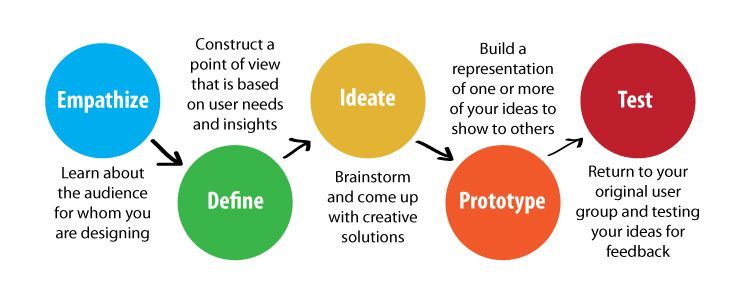
Now let's overlay the flow of design thinking. Here are two representations (with notations) of this:


Empathy is the obvious thing not mentioned in the Gold Standard. So, in my mind, a good PBL teacher must get their students looking at why we are doing this project. Who are we doing it for and why should the student care about doing it? Along with empathy at the start is building what I call empathic inquiry throughout the project. Are students getting feedback from those whom they are creating for throughout the project? 

And so, again from my perspective, doing gold standard PBL while following a DT path is the best of both worlds. These are not (and should not be considered) separate entities. What are we looking for in all of this? We want students who are aware of their surroundings; are aware of the needs of others; are inquisitive about how and why things are the way they are; and, who are given the chance to experience the creative process of imagining a result, attempting to create the result, reacting to feedback for improvement on this initial result, and persevering to complete their final result. 

I am now back in the classroom in an International Baccalaureate (IB) charter school in Texas. I am creating projects in coordination with my fellow teachers. I organize my project ideas using Project Based Teaching Practices from BIE and I use the DT flow shown above. I have found that it doesn't matter whether you think DT is better/different than PBL or that PBL is better/different than DT. What matters is that you are creating a classroom where students feel safe to take chances, make mistakes, and build resiliency. 

Monday, January 18, 2016

Using An Old Challenge to Teach Project Management

http://goo.gl/AK0vs
When I talk with teachers about getting started with PBL I often tell them to think of something they have seen done before and take the idea and make it their own. But I also caution them to think of their content first - what are the verbs and nouns in their standards? Unless they are incredibly comfortable with their standards it really doesn't make much sense to start with an idea and try to fit the standards.

Now that I'm teaching Design this frees me up to be more creative and experimental with where I ask my students to go with their learning. Unfortunately I have 7th graders who have been living, for at least a few years, in the world of "Learn the Content -then-Do a Project." In addition to teaching them about the Design process I have to teach them the the PBL process.

I'm attempting to create a classroom of asking questions, taking chances, making guesses, trying new things, and thinking about the client. Through the first semester my students have worked on projects that were centered on content standards for their science and Texas history classes. In science they needed to understand forces for the Rube Goldberg Machines they built. In Texas history they needed to understand French and Spanish settlers/settlements in the 17th and 18th centuries in what is now Texas to build models.

The content might have been for other classes but the creation and building were accomplished in my classroom. Now, with this next project, my students will be working for me (and for themselves). We are embarking on my version of the Cardboard Chair Challenge.

You might have guessed from the title of the project, that the main idea is to build a chair out of recycled cardboard and glue. But there is SO much more I want them to learn about managing a project. This, in reality, is a project management project.

To keep them focused on creating the chair and to make things interesting I have created an opportunity to have the students present to parents. There's nothing like an authentic audience to up the ante. To be honest, I don't really care whether they successfully build a chair in the short time period I have given them (but don't tell them that, shhhh.)

Things I am focusing on:
(1) Roles. In this project everyone has an individual role and everyone is responsible for making sure the final products are completed. There are 6 students in just about every group and I have 6 roles in each group. The roles are Group Leader, Work Leader, Group Liaison, Web Site Designer, Artistic Leader, and Promotions Leader.  For the first two weeks I'll be meeting with each of these role players every day to ensure they are on top of what needs to be done to be successful.
 (2) Leadership. Related to their roles, everyone in the group is responsible for something that they will need help with. Will they step up and be a leader to make sure the group is successful. One role I will be working very closely with is the Work Leader. I expect the Work Leader to create a Team Accountability Form and use it every day. The Work Leader needs to be on top of what every member of the group is doing and where they are on their individual time line.
(3) Working on both individual and group work. Can they work together on their product (the chair) while also working on their individual assignments based upon their roles?

I want my students to understand that their is a lot more involved in successfully completing a project besides the final product. My students are competing to create the "best" chair possible using just cardboard and glue. But they are also learning how to work together as a team.  And with that, I can truthfully say: I want them all to be winners.

Sunday, January 3, 2016

I Go From Project Idea to Project Launch (PBL with a DT Feel)

https://www.flickr.com/photos/nasahqphoto/
I've just completed a pretty darn nice 2 weeks off for the holidays. Tomorrow I head back to 2 days of PD before the students come back to me on Wednesday. I've been spending the last couple of hours fine tuning my first design project of the year.

This is my first year of teaching MYP Design at Meridian World School. And so I've been creating as I go, as far as what I cover next with my students. Things that work this year will be tweaked and recycled for next year. Things that didn't go so well will be revamped or scrapped for next year. It's all part of the DT mindset and, either way, I learn a ton along the way.

Back in August (2015) I decided that I wanted to do a Cardboard Chair project this year. There are several versions out there but I chose to follow this one. I modified it, as necessary, to meet the level of my 7th graders and the time I wanted to spend on this project. The beauty of this is that I am working with something that has worked in the past.

I took the major parts of the project as written ( Research, Design Sketches, Drawings, and Model) and I added a beginning (Admin) and an end (Build and Presentations). Then I went through each of these and wrote out some sub-parts. For example I listed time for building and presenting the prototypes for feedback prior to their final build.

Next steps were to figure out how many days and weeks it would take and to look at the school calendar and see what things might impact these times. In doing this I noticed that our Diploma Program (DP) students will be doing their Group 4 Projects at about the same time I wanted to finish my project. I had my Authentic Audience - DP Parents can help pick the design champions.

As I worked backwards on the calendar I started filling in the key steps and, before I knew it,  I was back to early January and I could start finalizing my plans for these first two weeks of the semester.

Let me go through my checklist:  I have a project launch day where we will assign groups, write group contracts, and do the Question Formulation Technique (QFT);  I have a presentation day and an authentic audience;  I have days for research on key components for my subject area (Form, Function, Resources);  Students will explore empathy through their design plans; and, Students will do research, create sketches, and will build prototypes to get feedback prior to their final build.

I have been able to marry most of the Gold Standard PBL elements with most of the Design Thinking elements.  This will be a five week project from launch to final presentations. It will encompass the majority of the first six weeks of the grading period. I'll need to add assessments and plan for materials but, in the end, I am all set for the first 6-weeks of the semester. In a couple of weeks I'll be ready to start finalizing my next project. I've already approached a gym teacher to design some exercise mats. I'll write about that one soon.


Thursday, December 10, 2015

Building Empathy Through Interviews

www.floridamemory.com/items/show/32039
7th graders are all over the map when it comes to emotions. So, on one level, you might think that it isn't hard to get them to develop empathy. But how many of your students, at any grade level, have conducted interviews to gain knowledge of their interviewee?

My first semester at Meridian school is winding up and I am still getting used to the timing of projects. That led to a two week period between the Thanksgiving break and final exams.

I knew that I wanted to introduce an interview process soon. I also wanted to include either the 7th grade ELA teacher or the PE Coach with a project early in the next semester. And then it hit me - 6 Word Memoirs.

As the name implies, students write about themselves by using only 6 words. After checking with the ELA teacher I found that she had just completed a unit on memoirs. And, after talking with a few students only a handful had done a 6 Word Memoir (6WM) in the past. And so it began...

On the first day I gave the students a post on interviewing like a pro. It doesn't exactly apply but I wanted them to think about what the pros think about before, during, and after an interview. To minimize time on the article I had them do a jigsaw and we discussed things they learned about what to do before you go to an interview; what you do during an interview; and what things to think about after the interview.

Then I paired them up (key word there, "I" paired them up).  Many were with people they don't normal hang out with so getting to know them became a harder task. I gave them 10 minutes to come up with a set of questions to use as openers. And, I instructed them to go down any path that became an obvious interesting topic that might be used to write a 6WM.

To help them think, I gave them a list of topics that might be good places to draw from for questions.
The trouble is I forgot about how the 7th grade brain works. Because I put a list in front of them, they couldn't come up with imaginative questions or question sequences to go deeper on any other topics than the ones I presented to them. I actually heard one boy ask another "Have you ever been married?" When I heard that question I asked why he had asked it. He said "because I had included "marriage" on my list of possible topics." Silly me; I was thinking that maybe there might have been an interesting wedding that they might have attended.

By the end of class I actually was pleased with the results from most of my students. They had asked good questions and had made good recommendations to their interviewees on what they should write their 6WM about.  Very few ended up needing help in understanding the process and how to make a relevant recommendation.

Before the next project starts I will be able to draw from this experience as we discuss interviewing to gain empathy. Because when the next semester starts (after our holiday break) I will be having my students interview clients or other pertinent people before they start brainstorming ideas. I feel better about their interviewing skills and I believe they will be better at identifying the needs and desires from those that they interview.

To finish the 6WM, I am having them go through a critique rotation today. They are writing their 1st draft and are presenting it to their small group. The small group is tasked with recommending at least one word to be changed to make the 6WM stronger. Then the students rotate to different groups and go through the process a second time.

They will be turning in an 8.5 in. by 11 in. paper with their 6WM on it, that has been decorated to help tell the story. These will be placed on our classroom wall so all of my classes can see what the others have written.

Sometimes a quick 2 week assignment can bring out a lot of learning. In this case my students have learned about how to be a good interviewer. My students have also learned more about their classmates. And, I have learned more about all of my students. Sounds like success.