Teach.com
Showing posts with label edublogs. Show all posts

Sunday, May 3, 2020

Anatomy of an Interdisciplinary Project

From http://messiahnetwork.org/2015/04/01/puppet-show-on-sunday-april-19/ 

December 16, 2016. That's the date on this draft post I was thinking about writing. It is another of my 10 "draft" posts I have on my blog. I'm about to shift this blog over to Wordpress and away from Blogger. I have 276 blog posts altogether. Most were written over a 4 year period when I was actively writing (2011 through 2015). 

There are many things to consider if you are thinking about doing an interdisciplinary project. The following project was created for 7th grade students at a K-12 charter school in Round Rock Texas. The project included the subjects of Theater Arts, Language (French and Spanish), and IB Design.

The most obvious thing to say about the project design process, with multiple subjects, is that there has to be an initial conversation between 2 or 3 (or more) teachers who want to work together. At this school that conversation happened between the theater teacher and the design teacher a few months prior to project launch.

The theater teacher wanted to do a puppet show "towards the end of the year." That initial discussion concentrated on how the design students would be involved. Could they build scenery, or props, or puppets for the show?  The decision was made to have the design students build the puppets. During this discussion came the idea that, maybe, the language classes could be involved. All of the 7th grade students, at this school, take either French or Spanish (and it is nearly a 50/50 split). The language teachers were approached with the project idea and they were excited to be a part of it.

In one day the theater and design teachers had gone from a simple conversation to a commitment by 5 teachers. The next step was to create a rough calendar. To properly do backward design the teachers had to start with the furthest item out. Scheduling the puppet show would drive the other dates. The puppet show date led to establishing when the puppets would have to be completed. Since the students would be reading stories in their language classes and the stories, in turn, would become the basis for a script, when to start reading the stories had to be entered into the equation.


Those first steps were items that each teacher had to negotiate so that the overall project was successful. Individually, the teachers had to plan their classes so that their part of the process was completed on time with success. For example, the Design teacher wanted time to build empathy and time to start the inquiry process. It was decided that the project entry event would happen in the design class. The design teacher created a problem statement and specific product do-dates for the building of the puppets.

The theater and design teachers decided that the students would all create the same type of puppet so that they could help each other. An interesting and common (for interdisciplinary projects) issue came to light at this stage: The students who were together in design were not all together in their theater classes. And, the language classes were different from design or theater. This was important because the groups in theater class, who were presenting a specific story, all took the same language. But that didn't mean they were in the same language class period. And when it came time for building puppets none of them might be in the same design class period. It must be said that this was not a deal killer - a minor headache? Yes A stop the presses moment? Definitely not.


So, how do you drive a project that kicks off in a design class; forces students to ask their language teachers for story or poem suggestions that they can read; and ends up with scripts being written in theater so that a puppet show can happen? The answer is actually pretty simple. Once teachers have due dates on the calendar you can let the students dictate the course of the project.

In this project students arrived in their design class and were given the task of building puppets for a puppet show in their theater class. In theater class they were told that they were going to be having a puppet show where they would be writing scripts based upon either French or Spanish children's stories that they would read in their language classes. And, finally, the students were told by their language teachers that they would be selecting children's stories to read that would be used for a puppet show in theater. The time it took for all students to get an understanding of the overall scheme of the project took less than a week.

As far as deep understanding this project worked well for sustainable inquiry. Many of the students were with a group of students creating a puppet show in their theater class, but never were in class with their group members again during the day. But puppets representing each character had to be built. Scripts had to be written based upon a story that each group member was reading and, since they weren't in the same language class, they had to trust that their group members were all at a point where they understood the story well enough to have input for the script they were writing.


Students rose to the occasion. They learned about puppetry from areas all over the globe. They read for understanding in their language classes and discussed the nuances of the characters in their stories. They wrote scripts and made puppets that truly reflected the character they were in their story. And, in the end, had a fun time performing puppet shows. 

Wednesday, April 29, 2020

Connecting Live With Educators

https://www.flickr.com/photos/nasahqphoto/

December 15, 2015. That's the date on this draft post I was thinking about writing. It is the second of my 10 "draft" posts I have on my blog. I'm about to shift this blog over to Wordpress and away from Blogger. I have 276 blog posts altogether. Most were written over a 4 year period when I was actively writing (2011 through 2015). Additional Note: This is written from the distant past when classes happened in a school builiding - do you remember those days? 

Here comes another Tweet about "A Live Webinar....about to happen! Join Us!" -or- "Join us Tuesday at 2 PM PST for the next .... "  Who are they addressing this to and how are those people able to attend this event?

I get so frustrated and angry with these "incredible opportunities" to meet/talk/listen to incredible brains in the education world, when that "incredible opportunity" is during my school day. Even when I was an instructional coach and my hours were much more flexible, it was hard to make most  of these times.

I'm convinced that once teachers leave the classroom and become "experts" they forget that not everyone is able to hang out for an hour during a week day. When was the last time a teacher had an hour for lunch? And, should it occur during a conference period, how many teachers are willing and/or free to give up that time for something else besides grading papers/talking with parents/ or meeting with other teachers or administrators?

I'm not sure what else to do. I suggest via tweets that there should be a different time. I comment on this issue whenever I can. But, still, most of the great live stuff happens between the hours of 11:00 AM and 5:00 PM EST during week days.

People say, "there are always the taped and archived videos available to watch." Sure, and if you wanted to interact with anyone about a statement or question, how would you do that?  With connectivity better than at any time in my 58 years, there has to be a way to make these events available for ALL teachers in the US. I realize that there are awesome things going on in Australasia and in Europe and the Middle East. I can't expect those things to line up with my work day.

When I get up on a Wednesday morning and head off to school, I should be able to look forward to an event that is happening that day. To realize this it would have to happen sometime between 6 PM and 10 PM EST that night. If I have a personal conflict or a school event that is scheduled for the same time, then I won't be able to make it.  But if I am free I'll be able to be there - live.

Here are three possible solutions: (1) Have a webinar or GHO once a month that replaces a weekly Twitter chat. Why couldn't we have a #PBLCHAT, for example, once a month where people could see each other and there could be presentations to watch and interact with? The Twitter stream could still be utilized for a back channel. (I understand that some chats, like #edchat, are probably too big to do this).  (2) have a monthly webinar or GHO at set times and days (such as the third Tuesday of each month) with a web page outlining the agenda, days or even weeks, in advance. (3) Have more "live" podcasts that are streamed. There are some good ones now. Let's increase these.

There is a solution. And there are multiple ways to get it done. But to start we need those folks who insist on having mid-day live events to have a mind shift. Start thinking of the dozens (hundreds?) of educators who miss really great stuff because they are - gasp - in their classroom teaching!

2020 update - In our current state of online learning, educators have found ways to connect in new and different ways. Zoom is the most common tool being used. And, I am seeing so many more webinars and "conferences" being conducted this way. Maybe this will force us to understand the importance of being able to reach educators when they are actually available.


Monday, April 27, 2020

Creating a Culture of Wonder

Photo by Samet Kurtkus on Unsplash
"SCHOOLS SHOULD BE BUILT AROUND STREAMS OF WONDER. THESE STREAMS OF WONDER SHOULD CONSTANTLY BE IN MOTION ALLOWING YOU TO DIP INTO THEM AGAIN AND AGAIN. " - Chris Fancher, Educator and Author

January 26, 2014. That's the date on the draft post I was thinking about writing. It is one of about 10 "draft" posts I have on my blog. I'm about to shift this blog over to Wordpress and away from Blogger. I have 276 blog posts altogether. Most were written over a 4 year period when I was actively writing (2011 through 2015).

So today I am cleaning up the pile of posts and I will start finishing some of the draft posts - starting with this one.

The idea for this post was brought about after attending an Educon conference. Educon conferences are one of the best conferences an educator can attend. I would recommend that you all put that on your educator bucket list.

I attended a session on "Wonder, By Design." The beauty of an Educon is that the room creates what the attendees get out of the session. In this case we were instructed to come up with a table manifesto.

I know from my notes that all of the people at my table I knew from Twitter. And, most of them I am still in contact with via Twitter 6 years later.

"Wonder By Design." 
I loved the initial brainstorming around that statement:
     Learning is an opportunity -- not a location.
     Curiosity builds on curiosity and questions lead to questions.
     Wonder and curiosity go hand in hand -- one builds on the other.
     Wonder evokes open-endedness.
     There is no limit to imagination.
     Schools should be built around wonder.
     Schools should be built around wonder and ideas of everyone.
     Wonder invites joy.
     No one has the right to steal someone else's wonder.
     Wonder is essential to learning.

You can see that we were ready to take the concepts of wonder, imagination, and curiosity and find a way to create a manifesto that could be applied to all of education. So what the heck is a manifesto? Well, it just happens to be "a written statement that describes the policies, goals, and opinions of a person or group." Therefore, we needed to take these statements and put them together for our manifesto.

What we found as we started working with these statements was that we were heading down a path that led to the idea of wonder flowing through a school. This moved us into various water analogies. Fountains of wonder. Waterfalls of wonder. Streams of wonder. Someone even brought up Herodotus and a quote of his about water (I told you these were some pretty smart educators at this conference).

And so our first group of ideas became
(1) We believe that wonder and curiosity work together -- you cannot have one without the other and each spurs new ideas, new possibilities, and new creativity.
(2) Wonder is essential to learning and can be reflected in our spaces, our practices, our mindset.

These were great on their own but we felt that they weren't manifesto-y enough. So that led to these two statements:
(1) Schools should be built around wonder.
and, (2) Schools must be streams of wonder that are constantlly in motion - carving new paths - which you can dip into again and again.

My take on these two give you the following as my education manifesto:

SCHOOLS SHOULD BE BUILT AROUND STREAMS OF WONDER. THESE STREAMS OF WONDER SHOULD CONSTANTLY BE IN MOTION ALLOWING YOU TO DIP INTO THEM AGAIN AND AGAIN.

How can you build streams of wonder in your school? How do you allow students to dip into their creativity and imagination as a matter of routine? We all need to pause and consider those questions for our own classroom, building, or district.

NOTE: If you like this post feel free to look through the archives (on the right side of the page). Most are about PBL and/or Math. And, stay tuned for the shift over to ChrisFancher.com. The webpage is already there but the posts need to be shifted over. Coming Spring/Summer 2020.


Thursday, December 27, 2018

5 Things to Jumpstart PBL in the New Year [Math Version]

@amyshamblen
   You've enjoyed the holidays and you have a few more days until school starts back up so you've been catching up on your reading. Several of your friends have gone to trainings during 2018 where they have learned about Project Based Learning and you are intrigued. But everything you have read gives you a headache because you couldn't possibly add anything to your full curriculum pacing guide. 
   This post is for you. And it's for anyone who wants to "just kick the ball down the PBL road." Where do you begin? How do you get started? Well, in my opinion, it should start with inquiry. 
    (1) Start every (yes, every) day with an opportunity for your students to ask questions of you and of each other around the topic of math. It does NOT have to be about the current thing you are doing in your math unit. As a matter of fact those who espouse spiraling in topics throughout the year would argue that you should choose things that are not in your current unit. And, it is ok to give a problem that you haven't covered yet. Let your students struggle with figuring out the answer and then let them know that they will be seeing many more problems like that in a few weeks. 
  Want a question to start it off? Look at the image at the top of the page.  Ask you students to estimate the number of total balls that were in the glass. Then ask them to estimate the volume of the glass. And, finally, have them estimate the volume taken up by the balls when they are all in the glass. An "extra credit" might be how many more balls could you add to the glass until it is full?  Notice there weren't any numbers given. There weren't any formulas given. Just tell them that there isn't a correct answer but there are an infinite amount of incorrect answers - those that came without sound reasoning. 
    (2) Encourage your students to reflect on what they already know and what they will need to know to be successful in the next unit. Start by going to the Extended Questions or Gifted and Talented Questions at the end of the chapter you are about to begin. Find a question that you can bring to life and assign it on the first day of the chapter. If you don't have something like that then explore online resources for questions about the topic you are about to cover and select a rich question. Make sure the question can not be solved on the first day by the majority of your students. Once you have shown the question to the class, ask them to come up with what information they need to know to be able to solve it. List these on the board. Check those items that the students have not yet covered. Explain to the students that these checked items will be what you will be teaching them in this unit. 
    (3) Give your students opportunities to discuss how to solve problems in groups. Give them problems that might have multiple ways of solving. Allow time for everyone to attempt the problems. Then have them form groups and take turns explaining how to solve the problems. Encourage multiple ways of solving by asking them to come up, as a group, with more than one way to get to the solution. Teach the students how to give constructive feedback for problems that are incorrectly solved. 
    (4) Find ways to have students present their ideas to the rest of the class. (a) Start safely by using a fishbowl where a group discusses solutions in their group while the rest of the class observes and takes notes on the discussion. Just make sure the observers are held responsible for giving constructive feedback to the group in the fishbowl. (b) Have students paired up (Pilot/Co-Pilot) with the understanding that each day will change whether it is the pilot or the co-pilot who is responsible for explaining solutions. When working with your lower groups you can have it that either can answer but the selected position must tell the other person if he or she isn't going to be directly answering. 
(c) Have a presentation day where students write their solutions on poster paper or on a white board. Then have a gallery walk where students give constructive criticism to their peers. 
   (5) Put it all together. (a)Give an assignment over a topic that has not been covered. (b) Create a knows and need-to-knows list that students generate about the assignment. (c) Give students opportunities to work in groups to find solutions to the the assignment. (d) Have opportunities for students to share what they know with others in the classroom. Include an end of chapter/unit day when the solutions are "officially" presented. 

    What I have just shown you (paragraph 5 above) is the basic structure of project based learning.  If you committed, today, to doing this for each of the units/chapters you have left for this school year then you and your students would benefit from the deeper learning that would occur. 
    Then, next Summer (after an incredible Spring), you would want to commit to continuing this process in the Fall semester. When you planned for the Fall you would look for a math topic that is related to a news item or other item of interest in your local community. You would, then, find a way to connect with someone involved with the community issue. Then you would figure an angle for your students to do some math to help solve the problem (or, as a minimum, have them find several possible solutions to the problem). Finally, you would make sure you have a presentation day that your students would be tasked with presenting their solutions to the community. That one problem would demonstrate what true PBL is all about. It would have a "real world problem," it would have inquiry, it would have collaborative work and discussion, it would have reflection and analysis, and there would be a public audience. 
     It is my belief that students need three things to help them go deeper in their learning: Something that makes them wonder; time to discuss what it is that they are wondering about; and a non-negotiable deadline where they have to tell someone, they don't know, all about this thing that they have been wondering about. 
Photo by Annie Spratt on Unsplash

     Following these steps will help your Spring semester be the best you've ever had. Isn't that what all teachers should wish for on this New Year's Eve?  Happy New Year and best of luck in the coming semester. 

Some books to help you on this journey: 
Jo Boaler's Mathematical Mindsets is just plain good reading. 
Geoff Krall's Necessary Conditions is about great math teaching.
My book, Project Based Learning in the Math Classroom, (co-authored with Telannia Norfar) will help you go deeper with what I have written in this post. This book is now available for pre-sale and will be out in April 2019. 

Thursday, July 28, 2016

Let's Make a Maker Space

https://hildakweisburg.com/2016/01/04/on-libraries-makerspace-magic/
Right up front I want to say that any school that has a Maker Space because that's what great schools have, is missing the whole idea. I think playing with things and trying out things is really cool. I do. But if we haven't thought through what we will have in our space then will it truly be a space for all students?

There's that WE again. When WE are thinking about a maker space, then the first thing to think about is who is this WE we are talking about. WE should include anyone who controls the purse strings for purchasing items. WE should include the students who will be using the space. WE should include parents who might want to be involved in the space. WE should include teachers who might want to encourage students to use the space but also might want to use the space themselves.

Purse String Holders - How much will it cost for the initial purchase of items, for the maintenance of items, and for the replacement of items? If WE haven't thought about those items then the space won't be a success.

Student Users - What do the students want to do in the space? And, at the same time, what should be included in the space that the students haven't even thought of wanting?

Parent Participants - Some parents always want to be involved with the school. Some parents feel that they just don't have time but they are willing to purchase/collect/make items for the school. What do the parents want for the space? Do they want time when they can use it? Do they have expectations for what happens when their child is in the space? Do they want to volunteer to be in the space so that other adults (from the school) won't have to be in there?

Teacher Participants - Do the teachers have a certain expectation for what items should be in the space? Do the teachers want to be able to send students to the space at any time, knowing that there will be an adult presence to monitor the kids? Are there other ways the space can be used?

Last year was my first year at my current school. Several times I was told that there were parents who wanted the school to have a maker space. Well, where would this space be? What are the hours of the space? Will there be a requirement that there has to be an adult in the space at all times - or could we have a certification program for our older students who could be in the space during their study hall or after school.

Here are my top dozen questions compiled into one list:

      1. What do the parents want?
      2. Where would the space be located?
      3. Who would monitor students while it is open? 
      4. What would be the hours that the space is open?
      5. Will parents be able to provide items for the space? 
      6. What is the initial budget for materials for the space?
      7. What is the annual budget for materials for the space?
      8. Would there be a certification process for any tools and for general safety?
      9. Will teachers monitor the space? And, if so, when is this going to happen?
    10. Will parents sign up to monitor the space? How does that look from an insurance stand point?
    11. What do the students want (at each level. We're K-12 2nd graders and 10th graders have different desires) ?
    12. Will students be allowed to leave their classrooms to go to the space to work? If yes, how do we make sure that there aren't too many students in the space?

http://www.fractuslearning.com/2016/01/26/how-built-school-makerspace/

And now, for my readers, help me compile a list of materials that should be in a maker space (leave your thoughts in the comments section). Who knows, maybe there'll be a grant with our school's name on it and we can get this thing off the ground.  Here's a general list to whet your whistle -

     A. Legos and a Lego Table, KNEX, Blocks
     B. Basic hand tools (screw drivers, hammers, allen wrenches, adjustable wrenches, pliers)
     C. Yarn and Thread
     D. Tools for knitting, crocheting, sewing
     E. Painting Supplies (But what, exactly???)
     F. Computers/laptops for online access
     G. Rulers, T-Squares, Straight Edges
     H. Paper of various types
     I. Nails, Screws, Bolts
     J. Circuitry and wire
     K. Various types of tapes and glues
     L. Storage Containers and Shelves
     M.Craft supplies (Popsicle sticks, tooth picks, material, card stock, cotton balls etc.)

Thursday, July 7, 2016

Design Thinking or PBL, A Chicken/Egg Scenario? My journey.

http://www.science20.com/gerhard_adam/chicken_and_egg_problem_view_evolution-107927
Last night I missed a great conversation during a Twitter chat hosted by #MeritKCI and involving my friends who frequent the #dtk12chat. As I was scrolling through the tweets from the chat I noticed some discussion of PBL and how different Design Thinking (DT) is from PBL. A blog post that was referenced (and also one of my favorites) was written back in 2012 by Ewan Mcintosh of Notosh.com.

What's missing in these 140 character exchanges is some historical perspective and some grounding in where classroom teachers are in 2016. Before going further though, it's important to understand where my belief system lies and where I come from. I love student exploration - fueling inquiry and that innate desire to learn about things. I am against grades and, instead, am for student assessment through creativity, self analysis, and reflection. I believe in backward design but also in problem creation. I am also grounded in where the education world is today.

Parents, and I'm one, want their kids to be able to "be a kid," to explore, and (at the same time) get into great schools that will introduce them to unique learning opportunities. These school should then provide a foot into the door of a company that will help the students pay off their college debt. Many (most?) of these "great" colleges require a certain score on a standardized test (SAT/ACT) and a certain class rank based upon a 4.0 grade point average.

High schools are charged with getting students college and, lately, "career ready." Students must learn certain things mandated by their community, their state, and by the national government. The national government creates a list of "standards" that must be met. The state government creates a list of standards that must be met. And then school districts create standards that their students must meet to be labeled a high school graduate. More and more of these standards include the words "Explore" and "Hands On" but it really is up to the the teachers to bring in the "how" to do that exploration.

At some point years ago teachers started finding ways to engage students in their learning through an idea of centering the learning around a specific task or problem.  Although the idea of teaching in a mode that was focused upon a project had been around for about a century, it was a couple of dozen years ago that this was labeled (as we know it today) as Project Based Learning or Problem Based Learning - PBL. Schools/Companies/Corporations in Northern California jumped into this and we suddenly had the Buck Institute for Education (BIE) and the New Tech Network (NTN).  As these entities trained teachers and/or opened PBL schools the popularity of this PBL-thing increased and more groups started training teachers in their version of PBL.
http://www.peertutoringresource.org/2014/07/a-quick-start-guide-to-using-project-based-learning-pbl-in-the-classroom/

Around the same time this was happening schools were rapidly removing "Shop" classes and other hands-on classes for students because schools wanted to focus on courses that were academically rich. But this wasn't happening everywhere. In Upstate New York a company was created that focused on engineering principles - Project Lead the Way (PLTW).  In 2010, as I finished my 2nd year as a math teacher in a New Tech Network school, I was given the opportunity to teach a PLTW class, Introduction to Engineering Design (IED), and I went to my first PLTW course. That same year I saw for the first time a Nightline piece about a company called IDEO.

I started thinking about the marriage of the design process and the pbl process. And, coincidently, I found out about and read a new book called Make Just One Change from the Right Question Institute.  If we could get students to ask more questions at the start of each project might we improve the student inquiry process? And, in turn, might we not help teachers see that we can allow students the opportunity to explore the content and not just follow a road map that we (the teacher) created?
From PLTW

In 2012 as I was about to "finally" figure out this PBL-thing that I was floundering in, I was promoted to an Instructional Coach position with the charge of helping a middle school bring in PBL as the primary mode of instruction. So, before I was able to perfect my own teaching practices I was asked to help a staff of nearly 50 learn and perfect the art of being PBL teachers. That's when I started to really see the push back from teachers who felt that they were in a no-win scenario: state test scores must improve and they must be doing PBL in their classrooms. We were a NTN middle school with a NTN coach but we weren't doing PBL the "right" way. After two years we all decided that the school and NTN needed a break from each other. And I felt like a completely incompetent instructional coach. Why didn't PBL succeed in this school?

Later that year I started the training to become a National Faculty member of BIE so that I could reflect on my own PBL knowledge while facilitating training for teachers in school districts who were looking for a way to bring this PBL-thing into their schools. While immersing myself in all things PBL I came across a group of teachers who were talking about using a design thinking approach (DT) in their classrooms. In discussions with some of the folks I considered to be PBL guru's I was told that these DT teachers weren't going deep enough with the content and that PBL was what really got students going deeper. "Wait," I thought, "wasn't the big push back to PBL the notion that in projects students didn't go deep enough - it was just bells and whistles?"

DT was undergoing the same scrutiny that PBL had when I first was exposed to it years earlier. And, I should add, I was still hearing that push back from teachers in PBL trainings - "How do we know that the students will understand the content to do well on standardized tests?" -and- "This will never fly with our parents/school board/students."  In 2015/2016 BIE and the National Faculty members took a hard look at what PBL should look like for all students and in all classrooms. Because every classroom is different we wanted to create a "standard" that all teachers should be striving for in their schools. We came up with what we now are calling Gold Standard PBL.

In introducing this new Gold Standard to teachers one aspect jumped out to me: we now want teachers getting their students to ask questions through the use of the Question Formulation Technique (QFT) from the Right Question Institute. I had first learned about the QFT when I read Make Just One Change. BIE was now specifically stating what I had thought about way back in 2012.

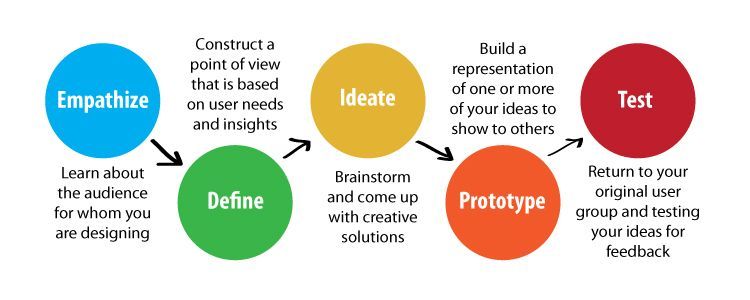
Now let's overlay the flow of design thinking. Here are two representations (with notations) of this:


Empathy is the obvious thing not mentioned in the Gold Standard. So, in my mind, a good PBL teacher must get their students looking at why we are doing this project. Who are we doing it for and why should the student care about doing it? Along with empathy at the start is building what I call empathic inquiry throughout the project. Are students getting feedback from those whom they are creating for throughout the project? 

And so, again from my perspective, doing gold standard PBL while following a DT path is the best of both worlds. These are not (and should not be considered) separate entities. What are we looking for in all of this? We want students who are aware of their surroundings; are aware of the needs of others; are inquisitive about how and why things are the way they are; and, who are given the chance to experience the creative process of imagining a result, attempting to create the result, reacting to feedback for improvement on this initial result, and persevering to complete their final result. 

I am now back in the classroom in an International Baccalaureate (IB) charter school in Texas. I am creating projects in coordination with my fellow teachers. I organize my project ideas using Project Based Teaching Practices from BIE and I use the DT flow shown above. I have found that it doesn't matter whether you think DT is better/different than PBL or that PBL is better/different than DT. What matters is that you are creating a classroom where students feel safe to take chances, make mistakes, and build resiliency. 

Tuesday, February 23, 2016

Thanking a Teacher In My Life

This past weekend I heard about a project being run by People Admin. They offered money to hear stories about people who inspired you to become a teacher.

So I sat down and whipped up this thank you to a teacher who inspired me to become a teacher. Enjoy -----

In 1990, at the age of 32, I was at a crossroads. My wife and I were both active duty Naval Officers serving aboard ships. Her ship was out of Norfolk, VA and my ship was out of Long Beach, CA. One of us needed to leave active duty. Over dinner we discussed the pros and cons of each of our futures in the Naval Service. My wife turned to me and said the magic words, “ At least you know what you want to do if you get out.” 

At that point she told me that I had always spoken of being a high school math teacher and a baseball coach. I never realized how often I had said that,  but I knew she was right. By the end of 1990 I was out of the active duty Navy and I was enrolled in graduate school. By the end of the Summer of 1992, I had my MSEd and my certification to teach math and science.

Where did this desire come from? Partly from the fact that I had two Great Aunts who were both teachers and my mother was a secretary in an elementary school. It seems that I had always been around educators and their “school talk.” But the main reason I ended up taking this route was because of my high school junior varsity (JV) baseball coach and math teacher - Mr. Pete Austin. 

Mr. Austin was a very demanding coach. You played his way or you didn’t play at all. Our JV baseball teams were a force to be reckoned with in our state. We played hard and we played the game with passion - just like our coach. He showed us that you would be rewarded for hard work.

In the classroom he was equally as demanding and he rewarded students who worked hard. He expected us to stand up and be bold with answers to questions. Wild guesses and “maybes” in a student’s answers were discouraged. And he wasn’t afraid to throw a chalkboard eraser in your direction to keep you on your toes - (always followed by a smile, I should add). 


One of his ways of helping us with low grades was to give a minimum grade of 50 on any assignment. The downside of this was that he would announce the members of the “50/50 Club.” I was a proud member of that club. But at the same time, my math skills were at such a high level that I went on to be a math major. At reunions we still talk about being in that infamous club.

My take away from this interaction was that teachers can be tough and demanding on their students while being compassionate and loving at the same time. There was never any doubt that Mr. Austin cared about us and he wanted us to be the best. That held true whether we were on the baseball diamond or in the classroom. 

I never made it back to thank this person who so inspired me in life. I only hope that one day his family will be able to see this and will take pride in knowing that he made a difference in our lives. What he showed me then is making a difference in my students lives today.

As I work with new teachers I make sure to encourage them to be firm and consistent in their classroom management. I make sure that they understand that they also need to show love and compassion. That’s the way I was treated in my high school pre-calculus class, that’s the way I treat my students, and that’s the way I want my own children to be treated in their classes. 

Thank you Mr. Austin for inspiring me to pursue this incredible journey.

---->   For those of you who remember Mr. Austin, feel free to leave your own memories in the comments below. I know that there are those who were afraid of that chalkboard eraser and Mr. Austin's style in the classroom and on the baseball field. I obviously loved how he worked and I know it helped make me a better person. So, if you do have any unpleasant memories, please remember to numb the sting before hitting submit.  Thank you.

Monday, January 25, 2016

Thoughts About This Coding Craze

In 1976 I set off to the University of South Carolina on a Navy ROTC scholarship to major in Math and Computer Science. In 1986 I was taking courses in computer architecture and the language ADA as I worked on my master's degree in Engineering. In 1992 I helped teach a computer class to teachers while being a graduate assistant and getting my master's degree in Education. I hope you believe that I get the importance of using computers as a tool.

Now, everywhere it seems, I keep reading how important it is for students to learn coding. I know the value of understanding the set up of code and algorithms. I can still remember my first assignment in the Fall of 1976 using PL1/PLC. It was to write a program to determine how many cars went through an intersection. The cars approached from each of the four cardinal points at different rates. The length of time the red, yellow, and green lights stayed on also varied. I may have loved math but this was a new animal and it hurt my brain.

But do we need to have every student take a coding course? And where, please tell me, do we get people qualified to teach these courses? I fear that the "Teacher as student" idea will trickle down here and will waste a lot of student time. Without proper guidance I see students going to places like Code.org and playing games. Oh they are being exposed to coding but are they learning the code or just the shape of the icon representing the code? And how many of the English, Math, Science, Social Studies teachers are going to really figure out how to work coding into their curricula?

Will administrators jump on board this coding train, having no understanding of coding themselves, requiring their teachers  to embrace this "coding stuff?" You bet they will. If there is funding and parent demand there will be administrators turning this demand on its head and requiring teachers to figure coding out.

I saw (and am still seeing) this with the topics of PBL, Inquiry, and (lately) Design. These are ideas that, when done well, are incredibly valuable and help students go deeper in their understanding of content. Because of publicity superintendents and principals get excited about things that will make their students be the best students. Suddenly they say things like, "This PBL stuff is good for our kids so lets get some training in it!" Grants get written and training begins. But soon the funding for the training dries up. And then we hear them say, "Now that we've trained some teachers, we need PBL to be done in EVERY classroom!"

But the schools/districts rarely get to the level where instructional coaches, assistant principals, and principals understand what they are seeing in the classroom.  It follows that these same academic leaders can't help their teachers grow in this new "PBL world" that they have created.

Will this happen in the world of Coding? Sadly, I'm leaning towards, "yes." Why? I'm willing to use myself as an example.

At my school parents and students demanded a computer science course. I was hired to teach Design Thinking, but I had a computer science background. So I was asked if I would teach a section of computer science. With very little time to come up with a plan, the school year started.  I decided that I would see what these students wanted in their computer science course. When I asked them I got the following: App Design, Web Page Design, Game Design, Coding, and Movie Creation. I let the students self-select into each of these areas and we spent the first semester exploring these topics with me as "facilitator of learning" and "calendar enforcer."

There was some good news from the semester.  Many of the students went way further than I thought they would go and learned more than I could ever have helped them learn. And, most of the students learned about what I expected they would learn in a self paced course. And, of course, there were some students who "also participated" in class. It was a pretty normal breakdown for students for any class and in any content. Nothing surprising there.

Still, I can't help but wonder what these same students could have done with a teacher who was at the school to teach students all about computers and coding. We're a small, academically oriented school with great parents and staff.  Hopefully, we will have a certified computer science teacher - or, at least, a person who loves to immerse themselves in all things computers. I'm not that guy. And, because I HAD to teach computers, I haven't put forth the effort required to make the course be truly awesome.

I find myself wondering: "how many teachers are going to be required to 'put coding into their course?'" If you aren't into computers, you aren't into computers. I love working with them and I want the latest app to use on my mobile device. But I'm not a person who spends hours coding. And I'm not a "maker." It isn't fair to my students to have me be their computer science teacher. They deserve better.

Schools and school districts are jumping on the coding band wagon. But do we suggest that all students learn coding when there aren't teachers in place to make it happen? It's hard enough to get a quality math teacher; or science teacher; or English teacher; or social studies teacher.  We need teachers who are passionate about their subject. Let's build capacity with computer science teachers before we suggest our students all take a class in coding.

Monday, January 18, 2016

Using An Old Challenge to Teach Project Management

http://goo.gl/AK0vs
When I talk with teachers about getting started with PBL I often tell them to think of something they have seen done before and take the idea and make it their own. But I also caution them to think of their content first - what are the verbs and nouns in their standards? Unless they are incredibly comfortable with their standards it really doesn't make much sense to start with an idea and try to fit the standards.

Now that I'm teaching Design this frees me up to be more creative and experimental with where I ask my students to go with their learning. Unfortunately I have 7th graders who have been living, for at least a few years, in the world of "Learn the Content -then-Do a Project." In addition to teaching them about the Design process I have to teach them the the PBL process.

I'm attempting to create a classroom of asking questions, taking chances, making guesses, trying new things, and thinking about the client. Through the first semester my students have worked on projects that were centered on content standards for their science and Texas history classes. In science they needed to understand forces for the Rube Goldberg Machines they built. In Texas history they needed to understand French and Spanish settlers/settlements in the 17th and 18th centuries in what is now Texas to build models.

The content might have been for other classes but the creation and building were accomplished in my classroom. Now, with this next project, my students will be working for me (and for themselves). We are embarking on my version of the Cardboard Chair Challenge.

You might have guessed from the title of the project, that the main idea is to build a chair out of recycled cardboard and glue. But there is SO much more I want them to learn about managing a project. This, in reality, is a project management project.

To keep them focused on creating the chair and to make things interesting I have created an opportunity to have the students present to parents. There's nothing like an authentic audience to up the ante. To be honest, I don't really care whether they successfully build a chair in the short time period I have given them (but don't tell them that, shhhh.)

Things I am focusing on:
(1) Roles. In this project everyone has an individual role and everyone is responsible for making sure the final products are completed. There are 6 students in just about every group and I have 6 roles in each group. The roles are Group Leader, Work Leader, Group Liaison, Web Site Designer, Artistic Leader, and Promotions Leader.  For the first two weeks I'll be meeting with each of these role players every day to ensure they are on top of what needs to be done to be successful.
 (2) Leadership. Related to their roles, everyone in the group is responsible for something that they will need help with. Will they step up and be a leader to make sure the group is successful. One role I will be working very closely with is the Work Leader. I expect the Work Leader to create a Team Accountability Form and use it every day. The Work Leader needs to be on top of what every member of the group is doing and where they are on their individual time line.
(3) Working on both individual and group work. Can they work together on their product (the chair) while also working on their individual assignments based upon their roles?

I want my students to understand that their is a lot more involved in successfully completing a project besides the final product. My students are competing to create the "best" chair possible using just cardboard and glue. But they are also learning how to work together as a team.  And with that, I can truthfully say: I want them all to be winners.

Sunday, January 3, 2016

I Go From Project Idea to Project Launch (PBL with a DT Feel)

https://www.flickr.com/photos/nasahqphoto/
I've just completed a pretty darn nice 2 weeks off for the holidays. Tomorrow I head back to 2 days of PD before the students come back to me on Wednesday. I've been spending the last couple of hours fine tuning my first design project of the year.

This is my first year of teaching MYP Design at Meridian World School. And so I've been creating as I go, as far as what I cover next with my students. Things that work this year will be tweaked and recycled for next year. Things that didn't go so well will be revamped or scrapped for next year. It's all part of the DT mindset and, either way, I learn a ton along the way.

Back in August (2015) I decided that I wanted to do a Cardboard Chair project this year. There are several versions out there but I chose to follow this one. I modified it, as necessary, to meet the level of my 7th graders and the time I wanted to spend on this project. The beauty of this is that I am working with something that has worked in the past.

I took the major parts of the project as written ( Research, Design Sketches, Drawings, and Model) and I added a beginning (Admin) and an end (Build and Presentations). Then I went through each of these and wrote out some sub-parts. For example I listed time for building and presenting the prototypes for feedback prior to their final build.

Next steps were to figure out how many days and weeks it would take and to look at the school calendar and see what things might impact these times. In doing this I noticed that our Diploma Program (DP) students will be doing their Group 4 Projects at about the same time I wanted to finish my project. I had my Authentic Audience - DP Parents can help pick the design champions.

As I worked backwards on the calendar I started filling in the key steps and, before I knew it,  I was back to early January and I could start finalizing my plans for these first two weeks of the semester.

Let me go through my checklist:  I have a project launch day where we will assign groups, write group contracts, and do the Question Formulation Technique (QFT);  I have a presentation day and an authentic audience;  I have days for research on key components for my subject area (Form, Function, Resources);  Students will explore empathy through their design plans; and, Students will do research, create sketches, and will build prototypes to get feedback prior to their final build.

I have been able to marry most of the Gold Standard PBL elements with most of the Design Thinking elements.  This will be a five week project from launch to final presentations. It will encompass the majority of the first six weeks of the grading period. I'll need to add assessments and plan for materials but, in the end, I am all set for the first 6-weeks of the semester. In a couple of weeks I'll be ready to start finalizing my next project. I've already approached a gym teacher to design some exercise mats. I'll write about that one soon.


Sunday, October 18, 2015

Still Ripping Educators Off

https://www.pinterest.com/pin/171347960792965587/
I started (this current round of...) getting upset about this (continuing) problem of educators being ripped off for supplies, a couple of weeks ago. I was talking about it with a fellow educator and he reminded me of a time when a teacher went to the vendor floor at a conference. She commented on how expensive this one item was and the vendor said, "Why are you upset? The school district pays for it anyways."

Those outside of the teaching profession assume that we get such a great deal and "the district just pays for things." Even if that WAS true, and it's not, I'm a tax payer in a school district and therefore I help put together the funds that are to be spent. I don't need my school district being ripped off when they are using my money!

So then, today, I wanted to price 4 inch to 6 inch balls that I want to use in a project down the road. I figured I'd start by looking at foam balls and that they would be the cheapest. Within minutes I had been to several sights, including Oriental Trading Co (a teacher go-to site) and Amazon.com.  I found what I was looking for in the 50 to 75 cents a ball range and was doing some mental calculations that I would need 50 to 75 dollars to get the 100 balls that I wanted.

Then I went to Discount School Supply. Doesn't that sound like some company trying to help us teachers out? Well, not so fast. These guys wanted $2 a piece for the balls. That is more than double the price - for foam-stinkin-balls! I would be more upset but I have seen this since my days in the military. "Oh, is that being purchased for a government entity? We'll mark it up 100%"

When you see the statistics about the amount of money a teacher spends out of their own pocket on school supplies each year (probably averaging in the $500 to $1000 a year for me) it really galls me that these places would charge double (and often 3 or 4 times) for something that could be purchased somewhere else. No wonder crowd funding sites are so popular with teachers (such as Donor's Choose).

I'm going to get balls for my project. I'll spend 50 to 100 dollars from the look of it. But I won't be spending any money at any of the "discount educator" sites. They can wait for the purchase order that I'm not filling out because I'm using my own money and NOT my school's money.  Grrrr...

You may return to your regularly scheduled lives.....(and I'm pretty happy that I kept my maturity with this post and didn't say anything like, "I got my balls in an uproar!" - That would have been wrong.)

Friday, October 9, 2015

You See, It Takes Time

https://www.flickr.com/photos/badboy69/
We are seeing a real dichotomy in education these days. Thanks to social media we are exposed to teachers, at all levels, doing wonderful things with their students. We're seeing students doing incredible things that they have chosen to do - not because they are completing an assignment that they have to do.  

We are seeing images of happy and excited people from gatherings of educators at edcamps, conferences, and webinars. And we're also seeing students in these images. Students - outside of the normal school day!

Then there is the reality of schools being labeled as "low performing." And students dropping out of school because they perceive life will be better with their gang family or, sadly, because they need to provide for their family. The images we see are of unhappy and, often, angry students. 

Between the two extremes lies the average school in the average district. And, at the average school, teachers are pressured to meet certain test requirements. To meet these requirements they must follow a strict curriculum with every day mapped out for them. They don't dare deviate from the course. The strict curriculum is designed by "experts" who know that teaching a certain topic in a certain way will guarantee the average student will succeed. And by succeed they mean pass the state test. 

But there are INCREDIBLE things going on all over the world. Students are going deeper in their learning. Student attendance rates are improving. Students are, (gasp), having fun and are enjoying learning. If students are attending classes and having fun in school then maybe, perhaps, their scores on state tests might just be improving! What a crazy concept!

Schools are having success. But there is this little statement that stakeholders in schools hate to hear - it takes time.  We saw it at Manor New Technology HS. My first year our scores in math were not good. There was hope that I, the "Old Math Teacher," could suddenly make things better. But what was lost on all of us was the fact that we were doing things differently. Our students had to learn how to learn and our teachers had to learn how to help students learn in this world of project based learning (PBL).  The superintendent and principal bought into the idea of "Trust the Process" and the teachers had incredible support and autonomy. We could try new things, and fail, without a huge to do about it.  And the school's scores started improving. 

All it took was time and the willingness of stakeholders to allow things to not go well so that we could figure out how to do it right. States and school districts have got to be willing to take risks and try new things with their students. Even though things might not immediately improve.  Are you willing to try something that excites students? Are you willing to try something that increases attendance rates? Are you willing to try something that keeps students from choosing life without school? Are you willing to give it 3 to 5 years? Are you willing to see test scores, possibly, stagnate or even go down? All we ask is for you to Trust the Process. Because, you see, it takes time. 

Monday, August 10, 2015

Putting Together a Design Class in a IB World School (Part 2)

Screen Capture from - https://goo.gl/VoUfRT
[NOTE: Originally written a week ago]
"So much time and so little to do. Wait a minute. Strike that. Reverse it. Thank you." Willy Wonka.

 Right now I'm feeling like a cross between the Scarecrow ( giving directions in OZ) and Willy Wonka these days. One minute I'm heading one direction and the next I'm heading in a completely opposite direction. But, the bottom line is that, wherever I end up heading needs to be a direction that helps our students and our school. I can live with that.

A long time ago (yesterday) I wrote the first part of this group of posts. At that time (yesterday) I felt like I was starting to see the light at the end of the tunnel - the tunnel of planning what my class would look like this year. Evidently the light I was seeing was a warning sign that said "Detour Ahead."
https://www.flickr.com/photos/shannonmary/
It now looks like my focus needs to be around the word Community. What does it mean to be a part of a community:   The classroom community, Our school community, Our "local community," and the world community?

The first project, that I will be doing with my science teacher neighbor, will now focus on my helping my teaching community. We will do the Rube Goldberg Machine because of the teacher's needs to teach certain concepts like momentum and speed.  We will build because of the need to have visual representations of the science concepts they will be learning. We will be doing all of the other components of the project so that everyone in my classroom community understands the parts of the design process.

For the school community I will be making sure that my students are learning the IB concepts at the MYP level. This will build on their years of learning these concepts at the PYP level. And throughout this unit, and the rest of the year, I will be referencing how our learning impacts (and is impacted by) the local and international communities.

It will be a time for me to join the Meridian World School community as well.  Let the school year begin!

[END NOTE: Stopping here. This was to have gone out last week. It's time to start writing the next post. School started today. And we are rolling! Come join my community. ]


Monday, June 29, 2015

In Which We Are Introduced to My New School

https://goo.gl/xAkChH
On August 10 I will be starting a new school year with new students at a new school. But what does that really mean? Every year we get new students. Every year is a new school year. The only really new thing is the school I will be working at - Meridian School in Round Rock Texas.

I interviewed for this school so I've actually stood in the building before. I even met a teacher from this school at SXSWEdu. He enlightened me about the fact that the school was K-12 (and not just an elementary school). I even suggested this school to another teacher-friend of mine and he not only applied for a job; he was hired to work there.

But my accepting the job is less than 2 weeks old and I haven't been able to go to the school since to see what it looks like or even finish all of the paperwork for the job application. Yet on August 10th there will be students walking into my classroom. It is NOT too early to start putting together my teaching strategy.

Meridian School. I am a retired Naval Officer and have taken many hours of navigation classes and have spent hours on the bridge navigating ships around the globe. So I know what a meridian is. But why meridian for the name of the school? I looked to see if there were other meanings to the word meridian and I found that there was one that I really liked (whether this meaning is the one meant by our school's founders, I'll have to wait to see):

 "Meridian - Any of the pathways along which the body's vital energy flows according to the theory behind acupuncture."

If I am to be a truly effective teacher I will want to know how to help the energy flow of my students along their meridian from head to heart to hand and back again.

During the next 6 weeks I will be writing posts about my preparations for this school, the school year, and my students. I will be discussing how I set up my room, how I design my calendar, how I design my first week's lessons to support a collaborative environment, what my parent/student/teacher communication plan will look like, what technology I will have and what choices I will make for the use of that technology, and much more.

I am a teacher who will be having inquiry, collaboration, questioning, and design at the heart of all that we do. All of those discussions and suggestions I've had with teachers (in my role as a coach) over the last three years will have meant nothing if I don't attempt to replicate those practices that I have talked (and written) about with such enthusiasm.

Come along with me on this trip of discovery. Discovery about who I really am; what I really believe; and, what I am ready to practice with my students.

Friday, June 26, 2015

I'm Not a Techie

Technology Cow via http://goo.gl/XR2MYi
In 1976 I went to the University of South Carolina to be a dual Math and Computer Science major. I got my math degree but gave up on computers after spending hours at the card punch machine at late hours on the university's one computer (that also had to do research and university business).

In 1985 to 1987 I attended the Naval Postgraduate School where I majored in Weapons Systems Engineering. I got a masters in engineering and the equivalent of a bachelors in physics while studying robotics. I worked on an IBM AT and an IBM XT for the robot work and I had a computer built to my specs for home where I could connect to the school's mainframe.

In 1992 I finished my masters in education and I co-taught a computers in the classroom course at Old Dominion University. We used the Apple IIE and I got to see teachers experience the world wide web (and accidentally find porn sites).

In 2008 I started work at Manor New Technology HS and the first question I was asked was whether I was a Mac or a PC person. I had never had a Mac but I knew the correct answer - give me a Mac! A couple of years later we added iPads to our repertoire.

During the years 2008 to present I actively reached out to like-minded teachers who were on Twitter, used Macs and iPads, and were discussing the future of education. So many of my first Twitter friends have become, what I like to call, Twitter Gods! They go to all of the cool conferences, hang out with all of the coolest people, and write books and have well-followed blogs. And many (most?) of them are techies. But not me.

That's right. I'm not a techie. I appreciate technology. I use technology to help me work more efficiently. I love discussing the latest apps, the latest websites, or a great blog post. But I'm not a techie. I still want to be where all of the "cool kids" are like SXSW, ISTE, or Ipadpalooza. But you know what? I can't afford to go to these conferences and I'm not in technology at a school district so I can't expect anyone to help me financially. Because I'm not a techie.

What I am is an education nerd. I love talking about curriculum and pedagogy. I love finding ways to help kids enjoy learning. I try new things in the classroom and want teachers to be better because our kids deserve the best teachers they can have. And if that means a cool app that improves inquiry and helps a student go deeper with their learning, then I'm all on board. But if a teacher has the latest bells and whistles tool, but can't reach the kids, then I don't want to hear about it.

Too many education conferences are focusing on those "precious" things called technology. Teachers by the hundreds are attending these and hanging out on the vendor floor with stars in their eyes. But what about learning about becoming a better teacher! What about finding ways to get students more involved with the content?

I just finished 3 weeks where I spent 11 of the 15 work days in front of teachers wanting to learn about PBL. They designed projects built on their content standards. And they designed these projects to help students make connections to the learning. Not once did I suggest an app, some software, or any hardware. Because I'm not a techie.

What I did do was help them understand how to turn the verbs written into their standards into some real-world, authentic, activity or problem. If, through examining this authentic problem their students might need some sort of technology we'd discuss that but technology was never at the center of the discussion. Because these were teachers - not techies.

It is 2015. It is time to FINALLY get to the point where we were at Manor New Tech 7 years ago - technology is the invisible tool. It is a tool. That is all. A tool. Like a pencil or pen. Like a chalk board, a white board, or a SMART board. A tool. We need to be tool masters not techies. What tool do we need to use to successfully complete this task? Whatever tool works best.

Can we finally stop sucking on the technology teat at education conferences? Probably not. But can we please get principals to the point where they see technology as just a tool? Then, and only then, will we be able to push teachers away from their "precious."

We just might get back to where we were in 1976 when I graduated from high school - we used the best tools that we had available. It just happened to be that it was a stick of chalk and a chalk board - although some of the rich kids could afford a Smith Corona electric typewriter - now THAT was cool!

Tuesday, May 26, 2015

If You Borrow It, Tell Someone

https://www.flickr.com/photos/kittiesmademedoit/
Those are words of advice given to me by my Father. Actually it was more like, "Hey, I don't mind if you want to use my tools but put them back - in the same spot - when you are finished."

Isn't that really the point of attribution? You are borrowing someone else's words or pictures. You may not be able to "put them back in the same spot," but you can send others back to the spot where they were found.

Too often on Twitter and Facebook I will see something that I know I have seen before. Almost invariably I do some digging and I find the original news article, blog post, or image that it came from.  Sometimes it is in a re-tweet (RT) and the person who originally tweeted it is the guilty party of not giving credit where it is due.

So, what should you do before you re-post something? My immediate answer may surprise you after my intro here. I say it depends. If you are in the middle of a twitter chat where 50 to 100 tweets are flying by every minute, then you may miss  hundreds of tweets with great nuggets by researching that one tweet. Just favorite the tweet prior to RT'ng it and then you can go back and give the original item the proper attribution after the chat.

If, on the other hand, you are seeing a tweet outside of a chat or in a slow moving chat then take the time to check it out and if the original person wasn't mentioned in the tweet take the time to include "via @originalperson" in your RT. If you need to modify the original tweet prior to RT'ng it to fit the "via," then remember you are now tweeting a Modified Tweet (MT) not a re-tweet.  Just use MT instead of RT and everyone will know what you did.

Finally, if you are going to be the original person putting something up on Twitter or Facebook, then take the time to craft your tweet or post so the attribution is included. If you can't find the person's Twitter handle through the twitter search do a web search using the person's name and the word twitter - "chris fancher twitter" for example.

If that doesn't immediately give you what you need, then research where this person works. Is he or she with a business, at a school or university, or in a school district? If nothing else find a twitter handle for the specific place of employment and include that.

Take the time to do the simple task of giving recognition to the originator of whatever "tool" you are using. You owe it to them and to your followers to do it right.