Teach.com
Showing posts with label education_reform. Show all posts

Thursday, July 7, 2016

Design Thinking or PBL, A Chicken/Egg Scenario? My journey.

http://www.science20.com/gerhard_adam/chicken_and_egg_problem_view_evolution-107927
Last night I missed a great conversation during a Twitter chat hosted by #MeritKCI and involving my friends who frequent the #dtk12chat. As I was scrolling through the tweets from the chat I noticed some discussion of PBL and how different Design Thinking (DT) is from PBL. A blog post that was referenced (and also one of my favorites) was written back in 2012 by Ewan Mcintosh of Notosh.com.

What's missing in these 140 character exchanges is some historical perspective and some grounding in where classroom teachers are in 2016. Before going further though, it's important to understand where my belief system lies and where I come from. I love student exploration - fueling inquiry and that innate desire to learn about things. I am against grades and, instead, am for student assessment through creativity, self analysis, and reflection. I believe in backward design but also in problem creation. I am also grounded in where the education world is today.

Parents, and I'm one, want their kids to be able to "be a kid," to explore, and (at the same time) get into great schools that will introduce them to unique learning opportunities. These school should then provide a foot into the door of a company that will help the students pay off their college debt. Many (most?) of these "great" colleges require a certain score on a standardized test (SAT/ACT) and a certain class rank based upon a 4.0 grade point average.

High schools are charged with getting students college and, lately, "career ready." Students must learn certain things mandated by their community, their state, and by the national government. The national government creates a list of "standards" that must be met. The state government creates a list of standards that must be met. And then school districts create standards that their students must meet to be labeled a high school graduate. More and more of these standards include the words "Explore" and "Hands On" but it really is up to the the teachers to bring in the "how" to do that exploration.

At some point years ago teachers started finding ways to engage students in their learning through an idea of centering the learning around a specific task or problem.  Although the idea of teaching in a mode that was focused upon a project had been around for about a century, it was a couple of dozen years ago that this was labeled (as we know it today) as Project Based Learning or Problem Based Learning - PBL. Schools/Companies/Corporations in Northern California jumped into this and we suddenly had the Buck Institute for Education (BIE) and the New Tech Network (NTN).  As these entities trained teachers and/or opened PBL schools the popularity of this PBL-thing increased and more groups started training teachers in their version of PBL.
http://www.peertutoringresource.org/2014/07/a-quick-start-guide-to-using-project-based-learning-pbl-in-the-classroom/

Around the same time this was happening schools were rapidly removing "Shop" classes and other hands-on classes for students because schools wanted to focus on courses that were academically rich. But this wasn't happening everywhere. In Upstate New York a company was created that focused on engineering principles - Project Lead the Way (PLTW).  In 2010, as I finished my 2nd year as a math teacher in a New Tech Network school, I was given the opportunity to teach a PLTW class, Introduction to Engineering Design (IED), and I went to my first PLTW course. That same year I saw for the first time a Nightline piece about a company called IDEO.

I started thinking about the marriage of the design process and the pbl process. And, coincidently, I found out about and read a new book called Make Just One Change from the Right Question Institute.  If we could get students to ask more questions at the start of each project might we improve the student inquiry process? And, in turn, might we not help teachers see that we can allow students the opportunity to explore the content and not just follow a road map that we (the teacher) created?
From PLTW

In 2012 as I was about to "finally" figure out this PBL-thing that I was floundering in, I was promoted to an Instructional Coach position with the charge of helping a middle school bring in PBL as the primary mode of instruction. So, before I was able to perfect my own teaching practices I was asked to help a staff of nearly 50 learn and perfect the art of being PBL teachers. That's when I started to really see the push back from teachers who felt that they were in a no-win scenario: state test scores must improve and they must be doing PBL in their classrooms. We were a NTN middle school with a NTN coach but we weren't doing PBL the "right" way. After two years we all decided that the school and NTN needed a break from each other. And I felt like a completely incompetent instructional coach. Why didn't PBL succeed in this school?

Later that year I started the training to become a National Faculty member of BIE so that I could reflect on my own PBL knowledge while facilitating training for teachers in school districts who were looking for a way to bring this PBL-thing into their schools. While immersing myself in all things PBL I came across a group of teachers who were talking about using a design thinking approach (DT) in their classrooms. In discussions with some of the folks I considered to be PBL guru's I was told that these DT teachers weren't going deep enough with the content and that PBL was what really got students going deeper. "Wait," I thought, "wasn't the big push back to PBL the notion that in projects students didn't go deep enough - it was just bells and whistles?"

DT was undergoing the same scrutiny that PBL had when I first was exposed to it years earlier. And, I should add, I was still hearing that push back from teachers in PBL trainings - "How do we know that the students will understand the content to do well on standardized tests?" -and- "This will never fly with our parents/school board/students."  In 2015/2016 BIE and the National Faculty members took a hard look at what PBL should look like for all students and in all classrooms. Because every classroom is different we wanted to create a "standard" that all teachers should be striving for in their schools. We came up with what we now are calling Gold Standard PBL.

In introducing this new Gold Standard to teachers one aspect jumped out to me: we now want teachers getting their students to ask questions through the use of the Question Formulation Technique (QFT) from the Right Question Institute. I had first learned about the QFT when I read Make Just One Change. BIE was now specifically stating what I had thought about way back in 2012.

Now let's overlay the flow of design thinking. Here are two representations (with notations) of this:

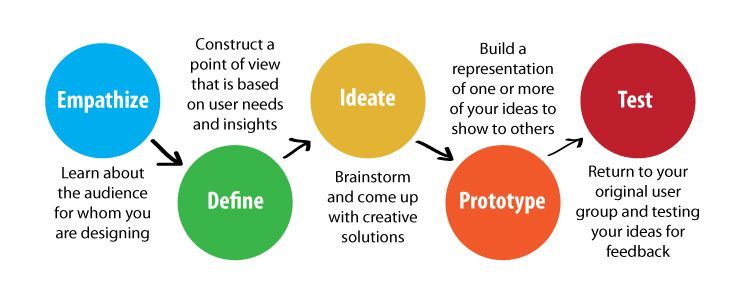
Empathy is the obvious thing not mentioned in the Gold Standard. So, in my mind, a good PBL teacher must get their students looking at why we are doing this project. Who are we doing it for and why should the student care about doing it? Along with empathy at the start is building what I call empathic inquiry throughout the project. Are students getting feedback from those whom they are creating for throughout the project? 

And so, again from my perspective, doing gold standard PBL while following a DT path is the best of both worlds. These are not (and should not be considered) separate entities. What are we looking for in all of this? We want students who are aware of their surroundings; are aware of the needs of others; are inquisitive about how and why things are the way they are; and, who are given the chance to experience the creative process of imagining a result, attempting to create the result, reacting to feedback for improvement on this initial result, and persevering to complete their final result. 

I am now back in the classroom in an International Baccalaureate (IB) charter school in Texas. I am creating projects in coordination with my fellow teachers. I organize my project ideas using Project Based Teaching Practices from BIE and I use the DT flow shown above. I have found that it doesn't matter whether you think DT is better/different than PBL or that PBL is better/different than DT. What matters is that you are creating a classroom where students feel safe to take chances, make mistakes, and build resiliency. 

Monday, January 25, 2016

Thoughts About This Coding Craze

In 1976 I set off to the University of South Carolina on a Navy ROTC scholarship to major in Math and Computer Science. In 1986 I was taking courses in computer architecture and the language ADA as I worked on my master's degree in Engineering. In 1992 I helped teach a computer class to teachers while being a graduate assistant and getting my master's degree in Education. I hope you believe that I get the importance of using computers as a tool.

Now, everywhere it seems, I keep reading how important it is for students to learn coding. I know the value of understanding the set up of code and algorithms. I can still remember my first assignment in the Fall of 1976 using PL1/PLC. It was to write a program to determine how many cars went through an intersection. The cars approached from each of the four cardinal points at different rates. The length of time the red, yellow, and green lights stayed on also varied. I may have loved math but this was a new animal and it hurt my brain.

But do we need to have every student take a coding course? And where, please tell me, do we get people qualified to teach these courses? I fear that the "Teacher as student" idea will trickle down here and will waste a lot of student time. Without proper guidance I see students going to places like Code.org and playing games. Oh they are being exposed to coding but are they learning the code or just the shape of the icon representing the code? And how many of the English, Math, Science, Social Studies teachers are going to really figure out how to work coding into their curricula?

Will administrators jump on board this coding train, having no understanding of coding themselves, requiring their teachers  to embrace this "coding stuff?" You bet they will. If there is funding and parent demand there will be administrators turning this demand on its head and requiring teachers to figure coding out.

I saw (and am still seeing) this with the topics of PBL, Inquiry, and (lately) Design. These are ideas that, when done well, are incredibly valuable and help students go deeper in their understanding of content. Because of publicity superintendents and principals get excited about things that will make their students be the best students. Suddenly they say things like, "This PBL stuff is good for our kids so lets get some training in it!" Grants get written and training begins. But soon the funding for the training dries up. And then we hear them say, "Now that we've trained some teachers, we need PBL to be done in EVERY classroom!"

But the schools/districts rarely get to the level where instructional coaches, assistant principals, and principals understand what they are seeing in the classroom.  It follows that these same academic leaders can't help their teachers grow in this new "PBL world" that they have created.

Will this happen in the world of Coding? Sadly, I'm leaning towards, "yes." Why? I'm willing to use myself as an example.

At my school parents and students demanded a computer science course. I was hired to teach Design Thinking, but I had a computer science background. So I was asked if I would teach a section of computer science. With very little time to come up with a plan, the school year started.  I decided that I would see what these students wanted in their computer science course. When I asked them I got the following: App Design, Web Page Design, Game Design, Coding, and Movie Creation. I let the students self-select into each of these areas and we spent the first semester exploring these topics with me as "facilitator of learning" and "calendar enforcer."

There was some good news from the semester.  Many of the students went way further than I thought they would go and learned more than I could ever have helped them learn. And, most of the students learned about what I expected they would learn in a self paced course. And, of course, there were some students who "also participated" in class. It was a pretty normal breakdown for students for any class and in any content. Nothing surprising there.

Still, I can't help but wonder what these same students could have done with a teacher who was at the school to teach students all about computers and coding. We're a small, academically oriented school with great parents and staff.  Hopefully, we will have a certified computer science teacher - or, at least, a person who loves to immerse themselves in all things computers. I'm not that guy. And, because I HAD to teach computers, I haven't put forth the effort required to make the course be truly awesome.

I find myself wondering: "how many teachers are going to be required to 'put coding into their course?'" If you aren't into computers, you aren't into computers. I love working with them and I want the latest app to use on my mobile device. But I'm not a person who spends hours coding. And I'm not a "maker." It isn't fair to my students to have me be their computer science teacher. They deserve better.

Schools and school districts are jumping on the coding band wagon. But do we suggest that all students learn coding when there aren't teachers in place to make it happen? It's hard enough to get a quality math teacher; or science teacher; or English teacher; or social studies teacher.  We need teachers who are passionate about their subject. Let's build capacity with computer science teachers before we suggest our students all take a class in coding.

Friday, October 9, 2015

You See, It Takes Time

https://www.flickr.com/photos/badboy69/
We are seeing a real dichotomy in education these days. Thanks to social media we are exposed to teachers, at all levels, doing wonderful things with their students. We're seeing students doing incredible things that they have chosen to do - not because they are completing an assignment that they have to do.  

We are seeing images of happy and excited people from gatherings of educators at edcamps, conferences, and webinars. And we're also seeing students in these images. Students - outside of the normal school day!

Then there is the reality of schools being labeled as "low performing." And students dropping out of school because they perceive life will be better with their gang family or, sadly, because they need to provide for their family. The images we see are of unhappy and, often, angry students. 

Between the two extremes lies the average school in the average district. And, at the average school, teachers are pressured to meet certain test requirements. To meet these requirements they must follow a strict curriculum with every day mapped out for them. They don't dare deviate from the course. The strict curriculum is designed by "experts" who know that teaching a certain topic in a certain way will guarantee the average student will succeed. And by succeed they mean pass the state test. 

But there are INCREDIBLE things going on all over the world. Students are going deeper in their learning. Student attendance rates are improving. Students are, (gasp), having fun and are enjoying learning. If students are attending classes and having fun in school then maybe, perhaps, their scores on state tests might just be improving! What a crazy concept!

Schools are having success. But there is this little statement that stakeholders in schools hate to hear - it takes time.  We saw it at Manor New Technology HS. My first year our scores in math were not good. There was hope that I, the "Old Math Teacher," could suddenly make things better. But what was lost on all of us was the fact that we were doing things differently. Our students had to learn how to learn and our teachers had to learn how to help students learn in this world of project based learning (PBL).  The superintendent and principal bought into the idea of "Trust the Process" and the teachers had incredible support and autonomy. We could try new things, and fail, without a huge to do about it.  And the school's scores started improving. 

All it took was time and the willingness of stakeholders to allow things to not go well so that we could figure out how to do it right. States and school districts have got to be willing to take risks and try new things with their students. Even though things might not immediately improve.  Are you willing to try something that excites students? Are you willing to try something that increases attendance rates? Are you willing to try something that keeps students from choosing life without school? Are you willing to give it 3 to 5 years? Are you willing to see test scores, possibly, stagnate or even go down? All we ask is for you to Trust the Process. Because, you see, it takes time. 

Friday, June 26, 2015

I'm Not a Techie

Technology Cow via http://goo.gl/XR2MYi
In 1976 I went to the University of South Carolina to be a dual Math and Computer Science major. I got my math degree but gave up on computers after spending hours at the card punch machine at late hours on the university's one computer (that also had to do research and university business).

In 1985 to 1987 I attended the Naval Postgraduate School where I majored in Weapons Systems Engineering. I got a masters in engineering and the equivalent of a bachelors in physics while studying robotics. I worked on an IBM AT and an IBM XT for the robot work and I had a computer built to my specs for home where I could connect to the school's mainframe.

In 1992 I finished my masters in education and I co-taught a computers in the classroom course at Old Dominion University. We used the Apple IIE and I got to see teachers experience the world wide web (and accidentally find porn sites).

In 2008 I started work at Manor New Technology HS and the first question I was asked was whether I was a Mac or a PC person. I had never had a Mac but I knew the correct answer - give me a Mac! A couple of years later we added iPads to our repertoire.

During the years 2008 to present I actively reached out to like-minded teachers who were on Twitter, used Macs and iPads, and were discussing the future of education. So many of my first Twitter friends have become, what I like to call, Twitter Gods! They go to all of the cool conferences, hang out with all of the coolest people, and write books and have well-followed blogs. And many (most?) of them are techies. But not me.

That's right. I'm not a techie. I appreciate technology. I use technology to help me work more efficiently. I love discussing the latest apps, the latest websites, or a great blog post. But I'm not a techie. I still want to be where all of the "cool kids" are like SXSW, ISTE, or Ipadpalooza. But you know what? I can't afford to go to these conferences and I'm not in technology at a school district so I can't expect anyone to help me financially. Because I'm not a techie.

What I am is an education nerd. I love talking about curriculum and pedagogy. I love finding ways to help kids enjoy learning. I try new things in the classroom and want teachers to be better because our kids deserve the best teachers they can have. And if that means a cool app that improves inquiry and helps a student go deeper with their learning, then I'm all on board. But if a teacher has the latest bells and whistles tool, but can't reach the kids, then I don't want to hear about it.

Too many education conferences are focusing on those "precious" things called technology. Teachers by the hundreds are attending these and hanging out on the vendor floor with stars in their eyes. But what about learning about becoming a better teacher! What about finding ways to get students more involved with the content?

I just finished 3 weeks where I spent 11 of the 15 work days in front of teachers wanting to learn about PBL. They designed projects built on their content standards. And they designed these projects to help students make connections to the learning. Not once did I suggest an app, some software, or any hardware. Because I'm not a techie.

What I did do was help them understand how to turn the verbs written into their standards into some real-world, authentic, activity or problem. If, through examining this authentic problem their students might need some sort of technology we'd discuss that but technology was never at the center of the discussion. Because these were teachers - not techies.

It is 2015. It is time to FINALLY get to the point where we were at Manor New Tech 7 years ago - technology is the invisible tool. It is a tool. That is all. A tool. Like a pencil or pen. Like a chalk board, a white board, or a SMART board. A tool. We need to be tool masters not techies. What tool do we need to use to successfully complete this task? Whatever tool works best.

Can we finally stop sucking on the technology teat at education conferences? Probably not. But can we please get principals to the point where they see technology as just a tool? Then, and only then, will we be able to push teachers away from their "precious."

We just might get back to where we were in 1976 when I graduated from high school - we used the best tools that we had available. It just happened to be that it was a stick of chalk and a chalk board - although some of the rich kids could afford a Smith Corona electric typewriter - now THAT was cool!

Tuesday, February 24, 2015

Another Take on Problem Based Learning for Math

https://www.flickr.com/photos/gpforeducation/
I have been wrestling with the marriage of Project Based Learning (PBL) and Math for nearly 8 years now.  A few years ago I moved towards Problem Based Learning (PrBL) instead of Project Based for math. It just seemed to make more sense.

With PrBL there are shorter time periods to complete a problem which, to a math teacher, frees up more time for "Math Skills." Of course a veteran math teacher, using inquiry-based teaching (PBL or PrBL fall into this niche), will find opportunities for practicing math skills.

Once a teacher decides to pursue PrBL, he or she will need to figure out which math units fit best. Or at least that is what I used to think. Now, after years of working with this, I realize that instead of figuring out which units and then what specific problems to work with, there is a better way.  Teachers need to start the planning process with great "Open-Ended Questions."

Now I use the term "open-ended" loosely because many of the problems I found with that label were actually closed problems.  The open-ended problems I am looking for may have multiple solutions but they may just have multiple paths that can be taken to get to an appropriate solution.

So here's a problem I found for middle school students (taken from the Math Forum):


I can see this being used as an introduction to area. During the first day's questioning I would hope there would be obvious questions about how to calculate area. But I would also hope to hear questions about whether the "whole number dimensions" have to be in feet. Could they be in "whole" inches? How about a question about whether "rectangular" means it has to be four sided - could it be a composite figure of rectangles? There might be a question that comes up that I would never think of.

The beauty of this is that the students can explore their specific questions to solve the problem going down a path of their choosing. At the end of the week the real question is: "Can the students solve a 4-sided, rectangular figure, with a length of L and a width of W?"

My big AHA! then was this - what if I found 20 or 30 or 50 great open-ended questions that represent content I want my students to learn during a school year?  I could then lay these questions alongside my district Year at a Glance or Pacing Guide to see where the questions would make sense on the calendar.

Now as a teacher gets to each unit they will already have 2 or 3 (or 5) open-ended questions that have been vetted. These will be the problems used in class to foster inquiry.  These problems will take 3 or 4 days from start to finish. There will be opportunities for questioning and brainstorming; creating drawings or other models; presentations; and reflections.

For example, the questioning and brainstorming might be completed on the first day. The modeling (along with the requisite critical thinking) might be on day two. On the third day there would be an opportunity for an informal presentation of how the groups solved their problems, followed by a reflection. On the last day of this PrBL there might be an assessment on the learning that was completed.

This all started from having a sound, content specific, question that fueled inquiry, questioning, and thinking. Using an open-ended question allowed students to go in different directions in pursuit of answers. Successful students ask questions, think critically, and defend their ideas. That is where deeper learning happens and that is how we help our students develop perseverance.


Sunday, February 8, 2015

What is Essential For Successful PBL?

   
http://earthmosaic.org/index.html
This year the Buck Institute for Education (BIE.org), of which I am on the National Faculty, is re-examining the "Essential Elements" for PBL.

As I was thinking about it I remembered that I have posted about these elements a few times, over the years, and I came across this post from July of 2013.

So, in the essence of recycling, please read it again, or read it for the first time, so that you too can begin thinking about what the Gold Standard should be for PBL:


THE NINTH ESSENTIAL ELEMENT OF PBL(7/7/13) -  I am about to work in my last co-facilitation with the Buck Institute for Education (BIE.org) doing what they call a PBL 101. A basic, 3-day, course in the planning, managing and assessing of a PBL project.

Within a project most people can agree that there are certain items that make it successful and BIE has narrowed the list down to 8 items that they call the 8 Essential Elements of PBL (see the diagram to the left).

Anyone who has truly done PBL knows that there must some sort of significant content, there must have been a way to establish a desire for inquiry (in this case by having a driving question and by overtly discussing what it is the students will need to know), and there must be a public audience so students feel an added desire to do their best.

Through group work, research, and the inquiry process students end up having to do, what most people call, 21st century skills.  These skills include, but are not limited to, collaboration, critical thinking, communication (orally and in writing), and creativity. Finally, there must be a chance for students to have their work assessed. At that point, they must be allowed to revise their work and reflect on their assessment. This ensures the final product is something the students are proud of and the product demonstrates the knowledge that the students have gained during the project.

As I said, most people can agree that these 8 elements are key components of a classroom or school that uses PBL as the primary mode of instruction. But these elements are not as connected as the diagram might suggest. The glue that holds these 8 elements together is the classroom, school, or even district culture. Culture is the 9th Essential Element. Without a proper culture students might not be allowed to have voice and choice in the products they work on. Without a proper culture students might not be willing to do revisions of their work or they may not feel a need to reflect on their learning.

Even the 21st century skills can be restricted when there is not a culture of collaboration; students aren't encouraged to think critically; student communication is not allowed or shown as unimportant; or when students have no outlet to show their creative side. Each of these issues with students comes directly from the way teachers and administrators interact.  If the teachers don't collaborate, communicate, or get a chance to try creative things in the classroom then there is a shadow upon the entire school culture that can't be ignored.

So, teachers, as you finish your PBL 101,  your New Teacher training with the New Tech Network, or some other PBL training this summer, remember to work hard and stay positive. You can do this. But get your fellow teachers and administrators involved in what you are doing. Get the PTA or other parent organization involved too. It is time to work on the entire educational system so that you and, more importantly, your students can be successful pursuers of inquiry.

Tuesday, January 20, 2015

Resolve to Stop Using the Word "Fail"

http://goo.gl/ssvt4z
This year I want to see educators using the word "fail" less. In 2013 and 2014 it seemed like it was the word to use when it came to discussing student resiliency.

Half a century ago Winston Churchill talked about failure not being fatal. He then went on to emphasize the importance of not giving up. That is the message we want our students to carry with them.

Unfortunately, in the world of education, we have associated the word "failure" with grades and academics. If you aren't very smart, you fail. If you aren't successful in a class you are a failure.  This all comes down to the idea that we must assign a grade to everything our students do in the classroom. 

So now schools are trying to have our students build grit. We hear about agency and wanting our students to never give up. There are dozens of posters out there proclaiming failure as a starting point. I was even guilty of printing out signs that stated "FAIL = First Attempt In Learning."

But what are we saying? Is it really OK for our students to fail at something on their first try? Don't we want to build a layer of knowledge so that our students feel somewhat successful on their first attempt? Don't we want our students attempting a second or third try because they are feeling like they are figuring it out?

We need to come up with another term besides "fail." Remove that term from your lexicon. Failure should only be used when a student is totally unsuccessful after multiple attempts. And, even then, we need to be there supporting them.

My nice-sounding suggestion has some hurdles if it were put into practice. There are those parents (and institutions) who consider grades more important than, or at least equal to, learning.  What if every kid who had a solid understanding of a concept passed? Then none of those students would be failures. Is that a bad thing? There still would be people who would want to know how the students compared on a pecking order.

Assessment and grading is such a big topic I'll leave those for another day. But let's pause before we use the word "fail." Let's not encourage students to fail first. Let's encourage them to try again. 


Monday, October 27, 2014

There Was Gold In Them There Colorado Hills

http://goo.gl/oNBuIc
A Gold standard for PBL - that's what the folks at BIE.org are trying to define. And we are reaching out to all of you who are practicing this in your classrooms and schools. This past week the National Faculty (NF) met for our Fall summit and we had some rich, deep discussions on the topic. My takeaways:

(A). Many people refer to our 8 Essential Elements for PBL. If we are defining the Gold Standard then we need to determine whether we keep these as they are; we change them all; or, we just change key elements. For our summit we decided to start here and we were shown a proposed new look that is far from the finished product. The original 8 elements will probably be changing slightly. For example, Public Audience might be replaced with  Public Product.

Outside of the original hexagon there might be a new layer of teacher/facilitator practices. The idea here is that the teachers will now have specific things to think about as they create,facilitate, and assess projects. My question on this layer is the shape - do we keep it hexagonal or do we use a circular or rectangular shape to show how this layer envelops all of the 8 essential elements.

Look for more on this as we go through the next few months and follow #goldstandardpbl on Twitter.


(B). In our signature PBL 101's we concentrate on helping teachers create projects and we refer to the importance of them taking their students' learning deeper. Who are we educating in these sessions? Adults, of course. 

We acknowledged that we need to do better at educating these teachers. To do this we need to increase our knowledge of adult learners. This was our next focus for our summit - the adult learner. As with all summits I was amazed by the level of knowledge of my fellow NF's. 

We looked at various aspects of learning and we had a very informed discussion from our own Jennifer Klein on the Male and Female Brain. She even gave us a diagram of the 8 essential elements with how each type of brain interacts with that element.

(C) Another key topic in our summit was the idea of PBL Sustainability. As one NF put it, for true sustainability we need to work ourselves out of a job. We want our clients creating a culture of collaboration on their campus. We want our clients growing their own PBL "experts." And, we want our clients creating a culture of learning for all of the stakeholders. Teachers should be co-creating projects with community members and students should be interacting with local companies.

When we have a sustained "gold standard" of PBL in a community or school we will truly have reached the gold standard for education. Then, in fact, we will have worked ourselves out of a job at BIE. And I'd be OK with that.

(D) With each summit I attend I find myself increasingly excited about working with this incredible group of NF's. They come from diverse education backgrounds and experiences and we push each other by questioning accepted norms.  

When you see the book on Gold Standard PBL come out (next Summer?), you can bet that it will have been discussed, analyzed, and vetted by some of the greatest minds in education. And, some of those minds will be BIE's own National Faculty. Feel free to add your thoughts via Twitter. Remember the hashtag: #goldstandardpbl.  

Sunday, August 24, 2014

Which Came First PBL or Small Group Instruction?


https://www.flickr.com/photos/smu_cul_digitalcollections/
Ye Olde Chicken-Egg story. Why am I wrestling with this? Because many consider me pretty smart about Project Based Learning(PBL). And, our school which calls itself a PBL school, is pushing small group instruction.

So, is PBL just a version of small group instruction? Not sure. And when you infuse a very structured form of small group instruction will teachers feel that they can't do PBL any more? Yes, unfortunately.

True confession. The title doesn't really align with what you are about to read but, hey, it got you to click on the link and start reading this, didn't it?

Right now our school is in its third year of using PBL as its primary mode of instruction. Now, primary is a funny word. Two years ago we started with our 6th grade teachers and many of them struggled to understand how to do a project. Many, however, excelled and became known for their expertise.

Last year we pushed PBL out in all three grades and also insisted upon having small group instruction. The same 6th grade teachers, who had success in the first year, continued to do well and incorporated a rotation to a teacher table into their daily process. A few additional 6th grade teachers took on "a project" during each semester. And, many teachers created projects during each semester. Almost all of the ELA teachers and most of the Social Studies teachers created classrooms with good to great small group rotations.

So, at the end of year two we had a large group of teachers doing good small group instruction. And, we had a large group of teachers who had run at least two projects during the year with varying levels of success. The best news was that we had teachers in both sets: a win-win situation! We decided to minimize change for year three and the word we used was "enhance." As in we will enhance our instruction.

Then we discovered Glenna Tabor and her Tabor Rotations process for small group instruction. If you get nothing else out of this post, go look at Glenna Tabor's stuff and, better yet, figure out how to get ALL of your math teachers to one of her trainings (or get her to come to your district). A day with her was one of the best PD's I have ever attended (if not the best ever).

Tabor Rotations is a VERY structured plan for small group instruction. And, that is its biggest strength. I held a half day training with math and math-inclusion teachers yesterday for our school district. We will be sending nearly 40 people to a Tabor Rotation training day in Dallas next month and I wanted to pre-teach some of the concepts and give them an overall view of the process. Our inclusion teachers summed it up best - "With Tabor Rotations you get all of the best practices for SPED and ELL students rolled into one package."

So, here's the dilemma - Tabor Rotations is very structured and many of our best PBL teachers are in the math department. Why is that a problem? Several felt that the structure doesn't work with what they do. With Tabor Rotations we have 4 heterogeneous groups for part of the week and 4 homogeneous groups the remainder of the week and these teachers are used to project groups of 3 to 4 students in each group. When you have a class of 30 students that means 7 to 10 groups for projects. Do we have 8 groups of students who are working on a project; a different set of 8 students working in their Tabor Rotation groups for a couple of days; and, a third set of 8 students working in their Tabor Rotation groups for the other days of the week?

And how do we do Tabor Rotations with research days and presentation days?

All of these questions are now fully engulfing my brain. Our teachers will be going to the training in two weeks and then I'll have other brains to help me figure this out. Because we will figure this out. PBL will work in every environment. PBL will help your students go deeper with their learning. Tabor Rotations will help your students go deeper with their learning too. The marriage of the two will be a truly magnificent thing. Just give us time to perfect it - because our teachers can, and will, figure this out.

Friday, July 25, 2014

Sometimes Words Do Hurt (My Brain)

https://www.flickr.com/photos/shebalso/
When you are over 50 years old and have been in a profession for a couple of decades, you see periods where certain buzz words are all the rage.

I googled "education buzzwords" and found a list of some words I have heard a ton within the last few years but the following is a list of words that I feel are use wayyyyy too much.

The list, in no particular order, includes: Rigor, Grit, Agency, Influencer, and the phrase "allow to fail." If you notice, with the exception of Influencer, they all deal with getting students to work through their problems. We want them to have stick-to-itiveness and not give up until they have exhausted all options. Or, most commonly, to persevere: To keep steadily on in doing or striving; persist 
 
So why can't we just say we want them to work hard and not give up? Instead we talk about increasing the "rigor" - does that mean they have to work harder to understand? Well last time I checked the ol' Funk and Wagnalls, rigor meant: Stiffness of opinion; Strictness; Harshness; Austerity . That definition doesn't make me want to do that to anyone. So why would we do it to our students? Intuitively I knew that someone must have the same issue with this word and so I started searching.

Having heard Alfie Kohn talk about his dislike for the word rigor I wasn't surprised to see his name linked to many posts on this word. But the best post I found was by Sheryl Nussbaum-Beach from a few years ago. It is called In Defense of Rigor and she has already done the legwork on this topic. Take the time to read through the comments left there before you decide what side you are on. In the end I still feel the same.  Why should I use a word that has so many meanings to so many people? It just renders it meaningless in the end. Head aching....

When I was 11 years old John Wayne starred in a movie called True Grit. I also helped my Dad a lot and I knew it was important to have the right sandpaper grit for the job that you were working on. Since I was young I took the word grit to be synonymous with the word tough. I was happy to go through life keeping those two words together in my mind. They remade the movie in 2010 and I went and saw it and liked it as much as the first one. It was different but still great. And I never had to think about the word grit because I already had my definition.

Suddenly I'm hearing that we want our students to have grit. The vision I had for 50 years of a stern, driven, and not so nice person wasn't what I wanted my students to turn into. But I do remember hearing the adage "grit and determination." As in he did the task with grit and determination.  It couldn't be that bad. Maybe, just maybe, it had more to do with perseverance than being a tough old goat.  Having to shift my definition of the word meant more headache.

About the same time the new version of True Grit was coming out I heard the New Tech Network talk about a new learning outcome. It was all about perseverance and the word they were using was agency. Like a travel agency? An acting agency? No, I was told, agency meaning students being resourceful and continuing to work on a project exploring all options rather than giving up.  Ummmm, isn't that perseverance?

I have been completely happy using the word perseverance all of my life. Why then, can't we use this word? It seems that "real" academicians use the word agency because it is better than perseverance. I'm sorry. Even though the word has grown on me I still prefer my own words and you won't hear be using agency in a sentence describing our students. That would just add more pain to my growing headache.

The expression "allow to fail" is used when you say that you want students to persist even if things aren't going well. We don't want teachers telling the students how to solve the problem, directly. We do want teachers guiding the students to find the answer though. I don't have a problem with this concept. But I do have a problem with the word fail. Allow students to struggle? I can live with that. I just don't want to have students who are so tied to academics to think it is ever OK to fail. So I won't be using that with my teachers. I will be asking them to get away from giving the students the answer quickly however. I want the students to struggle and then persevere.

So, out of the first 4 things I've talked about I only plan on using one of them. I will now add grit to my lexicon. As for the last word, influencer, you won't see me ever using it. I haven't really seen this word used in the education world, yet. But it is used in business all of the time. Anybody who is influential is an influencer. Well, duh, why don't we just call that person an influential person. Why do we have to make up a word?

So, if you have finished this post and I have swayed you in any way, please feel free to consider me an influencer. Just don't make me describe myself that way.

Wednesday, July 16, 2014

Yes There IS a Right Way to "Do PBL"

http://goo.gl/C3gteK
It started when I was contacted by some friends who were attending the Texas Computer Education Association (TCEA) conference this past February.  "What is your principal saying about PBL here - do you REALLY do this at your campus?" What they were talking about was someone who was filling our spot because we had to cancel at the last minute. And, what that person was saying was, "We do PBL at our campus and here's the issues we have had..."

"Doing PBL." I really, really hate that expression. You do NOT "do PBL." That's like saying you do teaching, or you do coaching, or you do directing music. If you are using PBL as a method of instruction then what you are doing is - wait for it.... - teaching. You are a teacher and you teach. I know, crazy, right?

When you teach do you use various forms of assessment? Do you randomize selecting students? Do you have warm-ups or do-nows? Do you pull students into small groups? Do you flip your class? I could go on and on. These are things that you "DO" in your classroom to be a better teacher and each of these things that you do are things that you feel comfortable doing and you feel that (or, even better, KNOW that) your students are getting a better education because of these processes.

Project Based Learning (PBL) incorporates any and all of the things I have just mentioned. That's because PBL wants us all to use best teaching practices. So, if you are a teacher using PBL in your classroom, then you DO great teaching. And, based upon who you are and who your students are, each PBL classroom might look very different.

If I go into a PBL classroom I will see students working collectively. Even if the teacher is doing a whole group lecture or all of the students are engaged with electronic devices, I can see that they are grouped.  Collaboration is a key element and I want to see the students working together towards a common goal.

If I spend time in a PBL classroom I should hear academic discussions and questioning.  I should see students doing some sort of reflection on their learning. I should see students assessing their personal and group progress and assigning future tasks. Like a good company, their groups should be working towards a common goal.

If I spend time in a PBL school I should hear and see everything I just stated in every classroom. And, because of the varying time requirements for projects, I should be able to see every stage of a project happening in the classrooms. I should see projects starting with entry events. I should see lectures and group work. I should see students preparing for their presentations. And, I should see presentations.

If you think you want to "do PBL," then the first thing you need "to do" is your homework. You are probably a beginner and you need to get a deeper understanding of how the PBL process works. Google "PBL" and you'll see hundreds (thousands?) of possibilities. On the first page of these you will see BIE.org and Edutopia.org. Both are incredible places to get knowledgeable about what PBL is and how to do it.

If you want to go deeper you can attend PBLU (a BIE product) remotely or you could get BIE to come to your school or district and train a group of you by attending a PBL 101. A PBL 101 is three days of helping you design one project while learning about how to plan projects and manage the process.

Once you have been trained; you have done a dozen or so projects; and you have been frustrated by not feeling like you are doing it right for the first 4 or so of those projects, then, and only then will you be allowed to say "I do PBL." I'll still think you're a rube for saying that but I won't correct you because you will now be beyond the beginner stage of practicing the PBL process.  So if you want to be incorrect go ahead - you've earned it.


Sunday, June 22, 2014

This Summer Put Something Into Your Sea Bag

http://www.zazzle.com/american_sailor_ww2_poster-228992068234634646
Early on in my 20 year Navy career I got great advice from a veteran sailor. He said to remember to put something into your sea bag whenever you have a unique experience. If that experience was bad, remember how it happened so you won't repeat it. If that experience was great, remember how it happened so you can replicate it or, at least, replicate the feeling you had when it occurred.


This Summer many (it should be most - don't get me started) of the teachers I know are busy attending trainings and conferences.  Ones I wish I were attending include ISTE, PBL World, and NTAC. There are also many great professional developments hosted by school districts and regional education centers.  In Manor, for example, there are some great hands-on tech trainings and trainings in backward design.

So what is your plan for taking away great nuggets of information and using these nuggets in your own professional growth? Don't have a plan? Then, other than great memories and, maybe, some great meals and networking, how will your teaching or leading change this coming school year?

Here are three ideas:

     1.  Use a recording device such as Livescribe, Notability or SoundNote. Then (the important step) listen to the recording and make notes on how these things will impact your classroom instruction.
     2.  Use twitter to tweet out important information using the appropriate hashtag. Then compile all of the tweets under that hashtag using something like Chirpstory or Hashtracking . Then (did I mention the important step?) make notes on how these things will impact your classroom instruction.
     3.  Write a blog post about the experience as soon as possible (same day) and explain how these things will impact your classroom instruction.

The common thread here is revisiting what you experienced and then reflecting on what you will use in your school and/or classroom.  It reminds me of what we tell our AVID students - you can have the best Cornell Notes, but if you don't do the final step of reviewing them each night then what good are they?

I hope you are one of those teachers who is out there experiencing all of the incredible opportunities that there are in the education world. I hope you are doing this with some old friends and, maybe, meeting many new friends. And, I hope, what you experience is going to be transferred to your students or staff.

So what have I done this Summer that I want to share? Well, for starters, I was able to facilitate 3 PBL 101's for BIE.org in Columbia, MS, in Glen Rose TX, and in Milpitas CA. I learned that there are some hungry teachers out there who are ready to improve their teaching strategies. They want to try an inquiry approach to instruction.

And I learned how I want to approach my own teachers this coming school year. I know my teachers are good at what they do but I also know they can even be better and that we need to raise the expectations of what we want them to do in the classroom.  We don't have to add anything new to what our teachers are doing. I need to help them plan better for PBL units; I need to spend more time in the classroom with them; and I need to model more lessons for them. Pretty simple really...

Gone are the days when teachers sat by the pool eating Bon Bons all summer long. Instead, those of us who are edumecated only sit by the pool for most of the summer. The rest of the time we're filling our brains (and not just our mouths).

Tuesday, June 10, 2014

Why Safe + Collaboration = Success

https://www.flickr.com/photos/sharynmorrow/
There are a few new twists to the PBL training we do with BIE and the one that stands out to me is the purposeful way we have teachers share their work with the others in the room. Of course, as with everything we do, we are modeling for the teachers and showing them activities they can do with their own students.  We want students comfortable sharing their work with their group members and with the entire class.

The way it is presented can be thought of as a gradual release method. We start, the first day, with an activity where teachers are drawing a simple picture and sharing it with one other person in the room.  At the end of the first day each teacher will present their project idea and their driving question to one other person for some feedback and discussion. At the beginning of the second day we have them present a poster of their project idea  and driving question which is seen by the entire room. This is done in a quiet gallery walk process. Finally, on day 3, they are presenting to a small group of teachers for feedback using a critical friends protocol.

Each activity is set with a protocol so that time is shared equally and the process is exactly defined. The combination of a set procedure and the fact that each teacher has discussed their project idea multiple times in multiple ways, allows for a thorough flushing out of potential pitfalls in the project plans. Additionally, there is time for reflection and revision between each of these phases.

How does this transfer to the student environment? What if you had activities, early in the school year (or beginning of semester), that allowed students a safe chance at sharing work that they are doing? What if you gradually increased the amount of exposure a student received from outside feedback within a project? What if you had multiple times for reflection and revision built into your project calendar?

Here's how a calendar for a 10 day project might look:

Day 1 - Collaborative Activity with a discussion about collaboration (15 minutes max) followed by the project Entry Event, Need to Knows, and Group Contracts.

Day 3 - Each member of every group is paired up with another student (not in their group) to share their initial project plans. ( 20 minutes max) Groups get back together and discuss thoughts and comments received during the sharing.

Day 5 - Each group creates a poster of their project plan and the class does a gallery walk with "I likes" and "I wonders" written on stickies and left on the posters. (30 minutes max - not counting time to make the posters) Groups get back together and discuss thoughts and comments received during the sharing.

Day 7 - Each group is paired with one or two other groups to do a critical friends (CFP) (20 minutes per group means 40 or 60 minutes for this process.)

Day 8 - Groups refine based upon the feedback and next steps from the CFP

Day 9 - Presentation preparation day (Have a Summative Assessment too?)

Day 10 - Presentation Day.

Day 11 - Reflection and Celebration Day (if doing back-to-back PBL units - regroup and do another collaboration activity. Remember to discuss what worked and didn't work in the activity so that they get a chance to reflect on the collaboration process).

What could (and, probably should) jump out at you about this calendar?  There are a couple of hours of time taken up during the 10 class periods just for the sharing process. 10 class periods of 90 minute block means you lose between 10 and 15 percent of your instructional time to do this. In a 60 minute class it's more like 20 percent of the time. If you did back to back projects for a whole year you could "lose" 36 days of instruction to this. That is one of the costs of doing PBL. There's no sugar coating this. But you need to do a cost benefit analysis to really determine whether it is right for you.

If students get 4 or more years of learning how to collaborate in a group; how to use critique, revision, and refinement in all that they do; and, they learn how to give constructive feedback to others, is that enough of a benefit to offset the time required to use this in your classroom?  If students start going deeper with their learning because they are continually discussing the learning process, is that enough of a benefit?  If we create people who are able to create safe collaborative environments in every business they get involved with, is that enough of a benefit?

We start the PBL 101 process with our groups telling us what traits they consider essential for the "ideal" graduate. I have never seen "can list the major battles of WWI," or  "can draw a to-scale drawing of a cell including the 5 most important components for mitosis," or " can show mathematically why the sum of two legs of a triangle will always be longer than the length of the third leg."  What we see are things about "life long learning," "stick-to-it-tiveness" and "being a good collaborator."  We must be willing to include activities that foster these "soft" skills.

I feel strongly that this process is worthwhile. But let's discuss it. Because, until I've considered all angles I haven't, necessarily, gone deep enough with this topic.  And my blog is a safe, collaborative site.


Friday, April 18, 2014

It All Starts At The Top

http://www.senate.gov/artandhistory/art/resources/graphic/xlarge/31_00012.jpg
I spent 20 years in the Navy. 10 years of active duty followed by 10 years of reserve duty. My wife spent 23 years in the Navy, all active duty. I've also been able to work in 8 different schools in 7 different school districts. The one constant for all of these? Leadership is the key to the business environment (school culture) and the environment/culture is the key to good things happening.

Wherever I have worked I have witnessed school leadership that has created a culture of winners. I've received Battle E's for ships and commands I have been associated with and I have been with schools that are at the top of their districts. And, I've known friends on other ships and commands or teaching in other schools or districts who have not been so fortunate.

What do all of these leaders have in common? A vision of where they want to be and a willingness to allow those who work for them to be successful. A third, important, factor is having a leader who insists upon everyone pulling their weight and working collaboratively toward a common goal.

I am currently working at a school with a leader who is never satisfied with the status quo. He demands more from himself and encourages each of us to do more than we might be comfortable doing. Because of this our school is becoming one of the best.

I can remember, two years ago, telling my 10th graders that I was leaving Manor New Tech to go to Decker Middle School (DMS) as the instructional coach. And, these 10th graders were only two years removed from that middle school. Their reactions were summed up by one of them saying, "why are you going to that ghetto school?"  In fact, when these 10th graders were first at DMS it was a ghetto school.

But in their last year at DMS, the school got a real leader. This man is still with the district but is now an assistant superintendent. He created a culture that was strict but showed these students that there was a lot of love and caring by their teachers and principals. This principal knew that the academics would come once the kids started caring about their school and about each other.

And so, last school year, DMS got a new principal and he and I came to this "ghetto school" unsure of what kind of a school it would be.  This principal immediately embraced the strict and loving culture that was in place and he brought in the next phase of progress - improved academics. He is a man who works hard to know everything he can about the academics that are going on in his building.

And this year we are reaping the benefits of having a strict, loving culture with sound academic principles.  We are seeing gains (modest, but steady) in all areas of our standardized testing scores and we are seeing a faculty who is becoming increasingly more aware of the importance of a collaborative environment for, not only the students, but for the adults in the building.

This school is heading fair and the sails are filling. As the great naval captain, John Paul Jones once said," I wish to have no connection with any ship that does not sail fast for I intend to go into harms way." Bring on those standardized tests. We are under sail and under way.